# The Science Behind Insulin Resistance: What Happens in Your Body
Insulin resistance is a condition at the heart of many metabolic issues, including prediabetes and type 2 diabetes. But what is actually happening inside your body when your cells become resistant to insulin? This article delves into the science behind insulin resistance, exploring the cellular mechanisms and the cascade of events that lead to this common but serious health problem.
## The Role of Insulin
To understand insulin resistance, we must first understand the role of insulin. Insulin, a hormone produced by the pancreas, acts as a key, unlocking your cells to allow glucose (sugar) from your bloodstream to enter and be used for energy. When you eat, your body breaks down carbohydrates into glucose, which then enters your bloodstream. In response, your pancreas releases insulin to help manage this influx of glucose.
This process is crucial for maintaining stable blood sugar levels and providing your cells with the energy they need to function. However, in a state of insulin resistance, this well-orchestrated system begins to break down.
## The Breakdown of Communication: Cellular Resistance
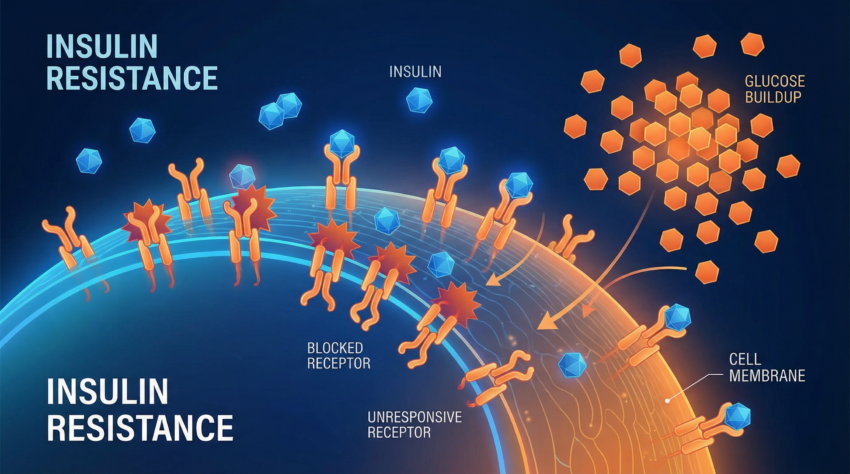
Insulin resistance occurs when your cells, primarily in your muscles, fat, and liver, stop responding effectively to insulin’s signals. The
key no longer fits the lock as easily, and glucose has a harder time entering the cells. This leads to a buildup of glucose in the bloodstream, a condition known as hyperglycemia.
### What Happens at the Cellular Level?
Several factors contribute to this breakdown in communication at the cellular level:
* **Ectopic Fat Deposition:** When the body has excess calories, particularly from a diet high in processed foods and unhealthy fats, it begins to store fat in places it shouldn’t, such as the liver and muscle tissue. This is known as ectopic fat deposition. The accumulation of fat molecules, such as diacylglycerol, within these cells interferes with the insulin signaling pathway. [1]
* **Inflammation:** Obesity and a poor diet can lead to chronic low-grade inflammation. Inflammatory molecules can disrupt insulin signaling and contribute to insulin resistance.
* **Mitochondrial Dysfunction:** Mitochondria are the powerhouses of our cells, responsible for generating energy. In insulin resistance, mitochondrial function can become impaired, leading to a buildup of metabolic byproducts that further interfere with insulin signaling.
## The Role of Different Tissues
Insulin resistance affects different tissues in distinct ways:
* **Skeletal Muscle:** As the primary site for glucose disposal, skeletal muscle plays a crucial role in blood sugar regulation. In insulin-resistant muscle, the uptake of glucose is significantly reduced, leading to higher blood sugar levels. [2]
* **Liver:** The liver is responsible for producing glucose when you’re not eating (a process called gluconeogenesis) and storing excess glucose as glycogen. In an insulin-resistant liver, the suppressive effect of insulin on glucose production is diminished. This means the liver continues to release glucose into the bloodstream, even when blood sugar levels are already high. [2]
* **Adipose (Fat) Tissue:** In healthy individuals, insulin suppresses the breakdown of fat (lipolysis). However, in insulin-resistant adipose tissue, this suppression is weakened, leading to an increased release of free fatty acids into the bloodstream. These free fatty acids can then travel to other organs, like the liver and muscles, and worsen insulin resistance there. [2]
## The Vicious Cycle of Hyperinsulinemia
As your cells become more resistant to insulin, your pancreas tries to compensate by producing even more insulin. This leads to a state of hyperinsulinemia, or high levels of insulin in the blood. For a while, this extra insulin can help maintain normal blood sugar levels. However, over time, the pancreas can become overworked and may no longer be able to keep up with the demand. At this point, blood sugar levels start to rise, leading to prediabetes and eventually type 2 diabetes.
Furthermore, high levels of insulin can themselves contribute to insulin resistance, creating a vicious cycle that is difficult to break.
## Consequences of Insulin Resistance
Insulin resistance is not just a precursor to type 2 diabetes; it is also associated with a range of other health problems, including:
* **Metabolic Syndrome:** A cluster of conditions that increase the risk of heart disease, stroke, and type 2 diabetes.
* **Non-alcoholic Fatty Liver Disease (NAFLD):** The buildup of excess fat in the liver.
* **Cardiovascular Disease:** Including high blood pressure and high cholesterol.
* **Polycystic Ovary Syndrome (PCOS):** A hormonal disorder that can affect fertility.
## Conclusion
Insulin resistance is a complex metabolic condition that arises from a combination of genetic and lifestyle factors. By understanding the science behind what is happening in your body, you can take proactive steps to prevent or reverse this condition. Through a healthy diet, regular physical activity, and weight management, you can improve your cells’ sensitivity to insulin and take control of your metabolic health.
### References
[1] Cleveland Clinic. (2022). *Insulin Resistance: What It Is, Causes, Symptoms & Treatment*. Retrieved from https://my.clevelandclinic.org/health/diseases/22206-insulin-resistance
[2] Freeman, A. M., Acevedo, L. A., & Pennings, N. (2023). *Insulin Resistance*. In StatPearls. StatPearls Publishing. Retrieved from https://www.ncbi.nlm.nih.gov/books/NBK507839/
 Urdu
Urdu  English