
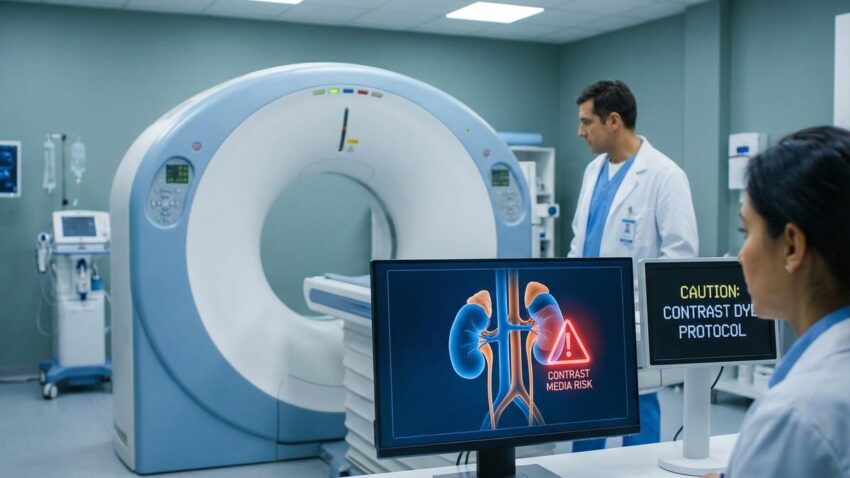
If you have diabetes and need a CT scan or angiogram, your doctor may mention concerns about contrast dye and your kidneys. This is a legitimate consideration — but one that is frequently over-stated. Here is what the evidence actually says.
What Is Contrast Dye?
Iodinated contrast media (commonly called “contrast dye”) is a substance injected intravenously before certain imaging procedures — CT scans, angiograms, and some X-rays — to make blood vessels and organs more visible. It is excreted almost entirely by the kidneys, typically within 24 hours in people with normal kidney function.
Contrast-Induced Nephropathy: The Real Risk
Contrast-induced nephropathy (CIN) — a temporary worsening of kidney function after contrast administration — was historically considered a significant risk, particularly in people with diabetes and pre-existing kidney disease. However, more recent evidence has substantially revised this view.
Large studies using control groups (patients who did not receive contrast but had similar baseline characteristics) have found that the rate of acute kidney injury in contrast-receiving patients is not significantly higher than in controls. Many cases previously attributed to contrast were likely due to the underlying illness that prompted the scan in the first place.
That said, people with eGFR below 30 mL/min do face a genuinely elevated risk, and extra precautions are warranted in this group.
If you take metformin, your doctor may ask you to stop it for 48 hours after receiving contrast dye. This is not because contrast damages the kidneys in metformin users — it is because if contrast does cause kidney impairment, metformin can accumulate to toxic levels, causing a rare but serious condition called lactic acidosis. This precaution applies primarily to people with eGFR below 45 mL/min or those having large volumes of contrast.
Protective Measures
If you have diabetes and kidney disease and need contrast imaging, the following measures reduce risk:
- Hydration: Intravenous saline before and after the procedure is the most evidence-based protective measure.
- Use the lowest effective contrast dose: Radiologists should use the minimum volume needed for diagnostic quality.
- Use iso-osmolar or low-osmolar contrast: These formulations are less nephrotoxic than older high-osmolar agents.
- Avoid nephrotoxic medications: NSAIDs should be withheld around the time of contrast administration.
- Check kidney function beforehand: An eGFR within the previous three months should be available before elective contrast procedures.
The risk of contrast dye to diabetic kidneys is real but has been overstated historically. For most people with diabetes and preserved kidney function (eGFR above 45), contrast imaging is safe with standard precautions. The main practical concern is metformin management: follow your doctor’s instructions about pausing metformin around contrast procedures, and ensure you are well hydrated.
 Urdu
Urdu  English