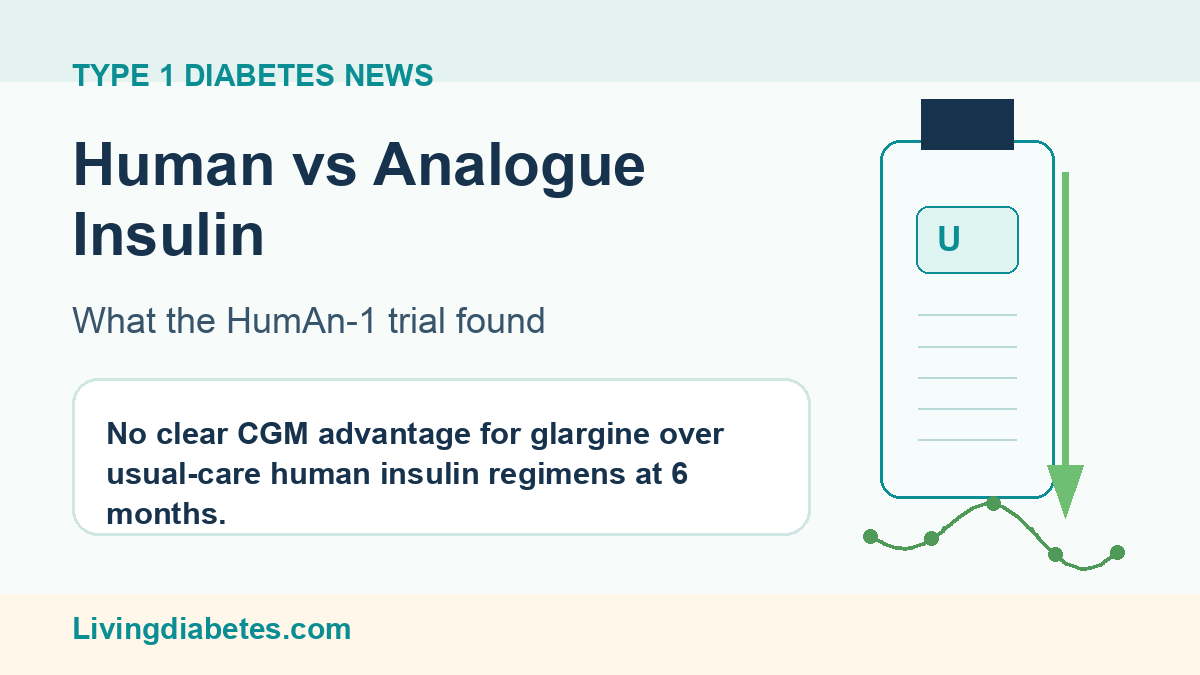
Short summary: A new randomized trial in The Lancet Diabetes & Endocrinology compared insulin glargine with usual-care human insulin regimens in young people with type 1 diabetes in Bangladesh and Tanzania. At 6 months, glargine did not clearly improve time spent in very low glucose or time in the target glucose range. The study is most useful as an access and expectations story, not as a reason for anyone to change insulin on their own.
What happened
The HumAn-1 trial looked at a practical question that matters in many countries: if a young person with type 1 diabetes is using human insulin for basal coverage, does switching to a long-acting analogue insulin clearly improve glucose outcomes?
The trial compared insulin glargine with usual care, which included isophane insulin, also called NPH insulin, or premixed 70/30 insulin. The participants were children, teenagers, and young adults aged 7 to 25 years with type 1 diabetes. The study took place at one site in Bangladesh and two sites in Tanzania.
What the trial measured
Researchers randomly assigned 400 participants to either insulin glargine or usual care. The main outcomes were measured at 6 months using blinded continuous glucose monitoring, or CGM. The two main measures were:
- Time in very low glucose: time below 54 mg/dL.
- Time in target range: time between 70 and 180 mg/dL.
These are meaningful outcomes for type 1 diabetes because time below 54 mg/dL reflects more serious hypoglycemia, while time in range gives a broader picture of day-to-day glucose control.
What the study found
At 6 months, the study did not find clear evidence that glargine improved either main CGM outcome compared with usual care.
- Average time below 54 mg/dL was 3.6% with glargine and 3.4% with usual care.
- Average time in range was 40.5% with glargine and 38.1% with usual care.
- Serious adverse events were uncommon in both groups.
The authors concluded that, in this trial and setting, glargine showed no evidence of improving time in very low glucose or time in target range compared with usual care at 6 months.
Why this matters
Analogue insulin can be very helpful for some people. It may offer a smoother basal profile, easier routines, or less nocturnal hypoglycemia in some situations. But this trial is a reminder that newer and more expensive does not automatically mean better outcomes for every person or every health system.
For families and diabetes teams, the message is not that human insulin is always equal to analogue insulin. The message is more careful: insulin choice should consider glucose patterns, hypoglycemia risk, access, cost, meal routines, education, monitoring, and follow-up support.
Important caveats
- The trial was open label, meaning participants and clinicians knew which insulin was being used.
- The CGM outcome assessment was blinded, which strengthens the glucose data.
- The results apply most directly to young people in the trial settings, not necessarily to every child or adult with type 1 diabetes.
- The study looked at 6-month CGM outcomes. It did not answer every long-term question about complications, quality of life, or health-system cost.
- Some people may still do better with analogue insulin because of overnight lows, variable schedules, injection timing, access to technology, or individual glucose patterns.
Practical takeaway
If you or your child uses insulin, do not change the type, dose, or timing because of this study. Type 1 diabetes always requires insulin, and changes should be made with a diabetes clinician who can review glucose data and hypoglycemia risk.
The practical lesson is to ask better questions: Is the current insulin plan affordable and reliable? Are lows happening often? Is overnight glucose a problem? Is CGM or finger-stick data showing a pattern? Are meals, school, work, and sleep schedules making the plan hard to follow? Those details matter as much as the insulin label.
Source and evidence summary
- Primary study: HumAn-1, a multicentre, open-label randomized controlled trial in The Lancet Diabetes & Endocrinology. PubMed record: PMID 42409045.
- DOI: 10.1016/S2213-8587(26)00097-5.
- Trial registration: ClinicalTrials.gov NCT05614089.