The short answer
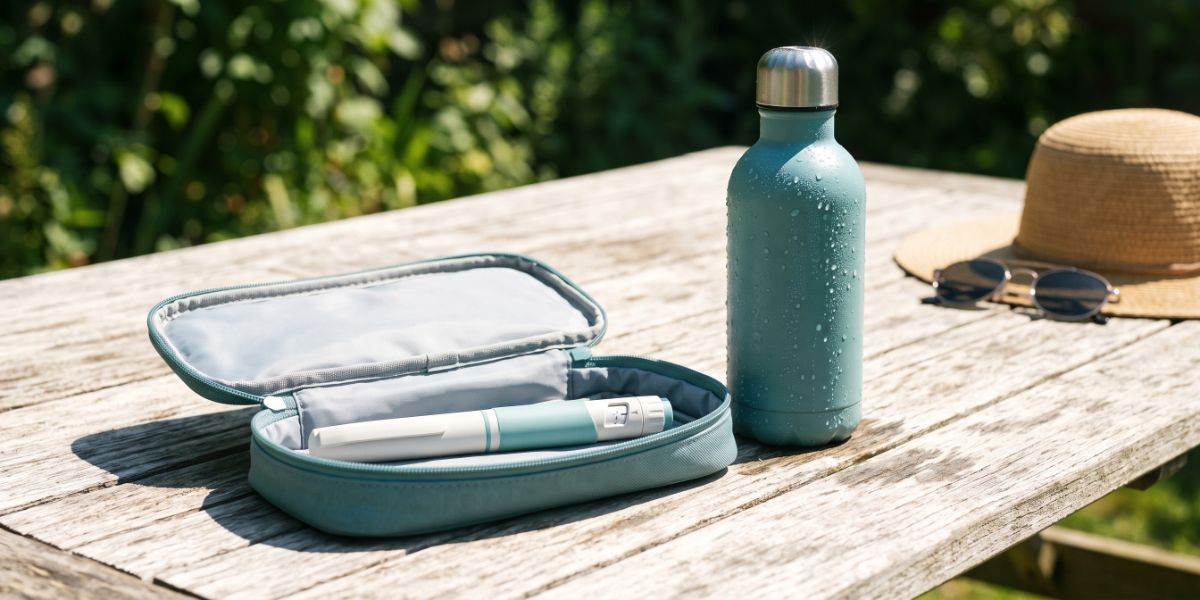
Keep insulin out of the sun and out of hot cars. Carry it in a cool bag, but never straight against ice. Insulin that’s been very hot or frozen should be replaced.
Look after yourself the same way. Drink water before you’re thirsty, stay in the shade, and check your blood sugar more often, because heat changes how your body uses insulin.
Here are the storage temperatures, how to travel with insulin, and how to stay safe yourself.
What temperature should insulin be kept at?
| Where | Temperature | How long it’s good for |
|---|---|---|
| Fridge (unopened) | 2 to 8°C (36 to 46°F) | Until the expiry date on the pack |
| Room temperature | 15 to 30°C (59 to 86°F) | Up to 28 days, opened or unopened |
| Hotter than 30°C (86°F) | It loses strength. The longer and hotter, the worse | |
| Frozen | Don’t use it |
Those figures are from the US medicines regulator. Your own insulin may differ slightly, so check the leaflet in the box.
For insulin inside a pump, the limit is body temperature. Insulin that’s gone above 37°C (98.6°F) in a pump should be thrown away.
How do I keep insulin cool when I’m out?
- Use a cool bag or an insulated pouch. Evaporative cooling wallets, the kind you soak in water, work without a fridge or ice.
- Don’t let insulin touch ice or a gel pack. Wrap it in a cloth or keep a layer between them. Freezing ruins insulin just as heat does.
- Never leave it in a parked car. Not the glovebox and not the boot. Cars get very hot very quickly.
- Keep it out of direct sun. At the beach or the pool, it goes in the shade, inside the bag.
- Flying? Insulin goes in your hand luggage. The hold can freeze.
Still take your supplies with you. Protecting them from heat doesn’t mean leaving them at home.
How do I know if my insulin has gone off?
You can’t always tell by looking.
Signs to watch for are clumps, frosting on the inside of the vial, a change in colour, or clear insulin that’s turned cloudy.
The other clue is your readings. If your sugars are running high for no reason you can see, and the insulin has been somewhere hot, suspect the insulin. Switch to a fresh pen or vial.
In an emergency, heat-exposed insulin is better than none. Use it, check more often, and replace it as soon as you can.
What about my meter, strips and sensor?
Heat affects them too. Keep meters, test strips, pumps and sensors out of hot cars and direct sun.
Strips are the most sensitive. Keep the lid on the pot. A strip that’s been baked can give a wrong reading.
Why does heat hit harder with diabetes?
Three reasons.
Sweating. Diabetes can damage the nerves and blood vessels that control your sweat glands. If you sweat less, you cool down less. That raises the risk of heat exhaustion and heat stroke.
Dehydration. High blood sugar makes you pass more urine, so you dry out faster. Water tablets add to it.
Insulin behaves differently. Heat changes how your body uses insulin. You may need to test more, and adjust your dose, food or fluids.
How do I keep myself cool?
- Drink plenty of water, even if you’re not thirsty.
- Go easy on alcohol and caffeine. Both can make you lose fluid.
- Skip sugary sports and energy drinks.
- Wear loose, light-coloured clothes, a hat and sunscreen. Sunburn can push blood sugar up.
- Do your exercise early or late, or indoors.
- Don’t go barefoot, even on the beach or by the pool. Hot sand and paving can burn feet that don’t feel it.
- Use air conditioning if you have it. In very high heat, a fan alone may not be enough.
Humidity matters as much as temperature. When the air is humid, sweat can’t evaporate, so you don’t cool down. Take extra care from about 27°C (80°F) in the shade with humidity of 40% or more. In full sun it can feel up to 8°C (15°F) hotter.
Should I check my blood sugar more in hot weather?
Yes. Check before, during and after activity, and watch for lows in particular.
A hypo can feel a lot like being too hot: sweaty, shaky, weak, light-headed. If you’re not sure which it is, test. See low blood sugar for what to do.
When is it an emergency?
Heat stroke is a medical emergency. Call for help if someone is very hot and confused, has stopped sweating, has a fast pulse, or collapses.
Move them somewhere cool and cool them down while you wait.
The bottom line
Insulin likes the same conditions you do: cool, shaded, never frozen.
Carry it in a cool bag, keep it away from ice and out of the car, drink water, and test more often when it’s hot.
More on heat, travel and fasting is in our guide to diabetes through the year.
Sources
- Centers for Disease Control and Prevention. Managing diabetes in the heat.
- US Food and Drug Administration. Information regarding insulin storage and switching between products in an emergency.
General public information, not personalised treatment advice. Children, pregnancy and complex health conditions need individual specialist advice. Don’t start, stop or change a medicine without speaking to your own healthcare team.