
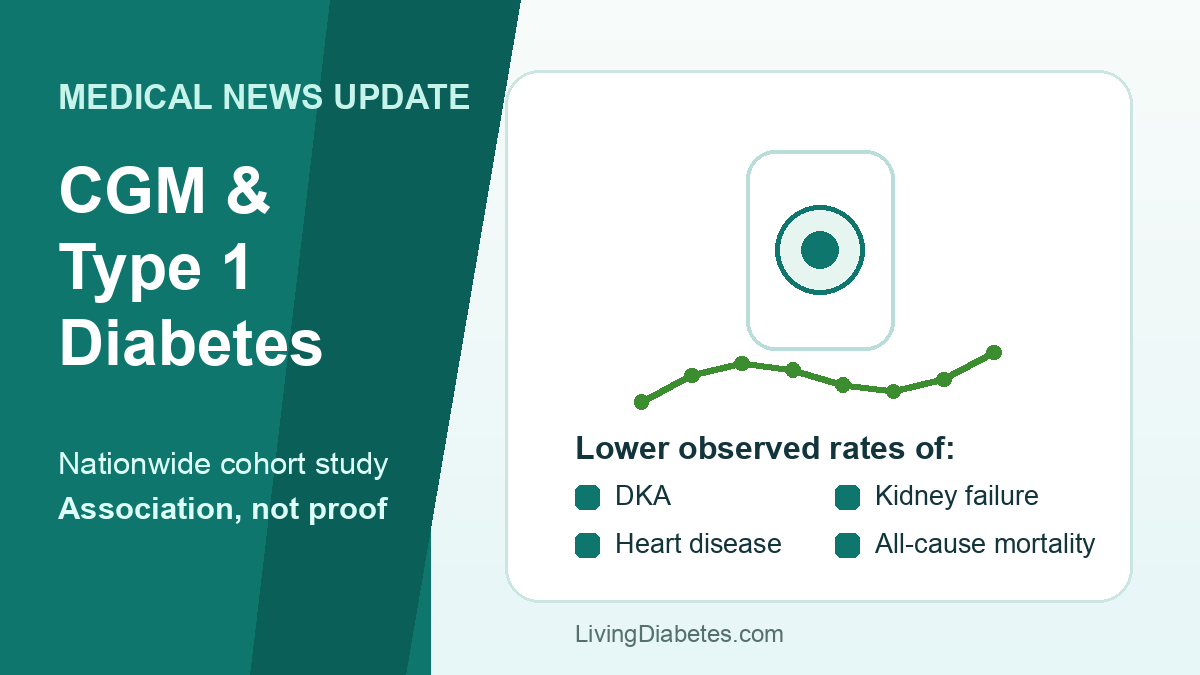
Short summary: A nationwide Korean cohort study in adults with type 1 diabetes found that continuous glucose monitoring, or CGM, use was associated with lower rates of several serious diabetes-related outcomes. The study does not prove that CGM alone caused those lower risks.
What happened?
Researchers studied adults with type 1 diabetes who were receiving intensive insulin therapy. The analysis used Korean National Health Insurance Service Cohort data from 2016 to 2022.
The study included 17,018 adults: 8,509 CGM users and 8,509 non-users. Researchers compared diabetic ketoacidosis, severe hypoglycaemia, end-stage kidney disease, cardiovascular disease, and death from any cause.
What did the study find?
Compared with non-users, CGM users had lower rates of several outcomes:
- Diabetic ketoacidosis: adjusted hazard ratio 0.40, 95% CI 0.33 to 0.48.
- End-stage kidney disease: adjusted hazard ratio 0.43, 95% CI 0.32 to 0.56.
- Cardiovascular disease: adjusted hazard ratio 0.28, 95% CI 0.23 to 0.33.
- All-cause mortality: adjusted hazard ratio 0.38, 95% CI 0.32 to 0.46.
Severe hypoglycaemia was comparable between CGM users and non-users. The reported adjusted hazard ratio was 0.92, with a 95% confidence interval of 0.77 to 1.10.
Within the CGM group, outcomes also changed after CGM was started. Mean severe hypoglycaemia frequency decreased by 61.5%. DKA frequency decreased by 60.0%, and cardiovascular-related hospitalisation or emergency department visits decreased by 50.0%.
Why this matters
CGM is often discussed in relation to day-to-day glucose monitoring. This study looked at larger outcomes, including ketoacidosis, kidney failure, cardiovascular disease, severe hypoglycaemia, and mortality.
For adults with type 1 diabetes, these outcomes are clinically important because they relate to emergency care, long-term complications, and survival.
The important caveat
This was a nationwide cohort study, not a randomized trial. It can show that CGM users had lower rates of several outcomes, but it cannot prove that CGM alone caused those lower rates.
People who use CGM may differ from non-users in ways that are difficult to fully measure. Access to care, diabetes education, technology support, health behaviors, and other factors may influence outcomes.
The study was conducted in Korea within a specific health system. Results may not apply in exactly the same way in every country or care setting.
Practical takeaway
This study adds population-level evidence that CGM use in adults with type 1 diabetes is associated with lower rates of several serious outcomes. It should be interpreted as supportive observational evidence, not as proof of cause and effect.
For individual decisions about glucose monitoring technology, people should use guidance from their own diabetes care team, local access rules, and their personal clinical situation.
Evidence and source summary
- Study type: Nationwide observational cohort study.
- Population: Adults with type 1 diabetes receiving intensive insulin therapy.
- Data source: Korean National Health Insurance Service Cohort, 2016 to 2022.
- Study size: 17,018 adults, including 8,509 CGM users and 8,509 non-users.
- Main finding: CGM use was associated with lower rates of DKA, end-stage kidney disease, cardiovascular disease, and all-cause mortality.
- Severe hypoglycaemia: Similar between users and non-users, but lower after CGM initiation within the CGM group.
- Limit: Observational findings cannot prove cause and effect.
Sources
- PubMed: Continuous glucose monitoring and risks of acute and chronic diabetes-related complications and mortality in adults with type 1 diabetes
- Diabetologia DOI: 10.1007/s00125-026-06709-2
How we checked this article
OpenAI medical accuracy review: The draft was checked for patient-safety framing, unsupported claims, study design, statistics, and exaggeration. The wording was kept cautious because the study is observational.
OpenRouter/Perplexity verification: The main claims and numbers were checked against PubMed-indexed source material. Verification required the article to state association rather than causation.
This article is for general education only and does not replace care from your own clinician.