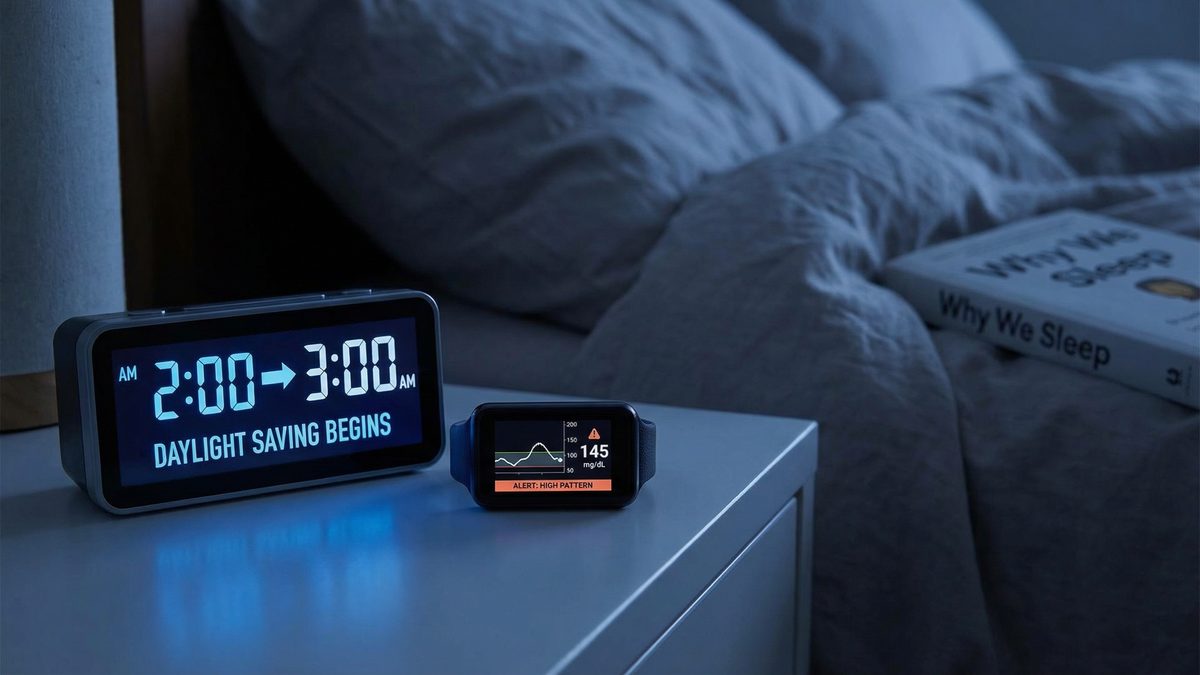
Daylight saving time can feel minor, but a one-hour shift can affect sleep, meal timing, medicine timing, exercise, and glucose checks.
Quick summary
Most people adjust without major problems, but people using insulin, pumps, CGM, or time-sensitive medicines may need a little planning.
Key takeaways
- Sleep disruption can change appetite, activity, and glucose patterns.
- Medicine timing may matter for insulin or other scheduled medicines.
- Device clocks should be checked after time changes.
- Do not make major dose changes without a care plan.
Before the clock changes
- Check pump, CGM, meter, and phone time settings.
- Keep meal and medicine timing as consistent as possible.
- Watch for lows if meals or activity shift.
- Plan a simpler routine for the first day or two.
- Ask your care team if insulin timing is complicated.
After the shift
Look for patterns rather than reacting to one reading. A few days of sleep disruption, stress, or changed meals may explain unusual numbers.
If readings are repeatedly unsafe or lows increase, ask for help rather than guessing dose changes.
People who use insulin pumps, connected pens, CGM alerts, or phone-based diabetes apps should make sure device clocks match the real local time. A wrong clock can confuse dose history, trend review, alerts, food logs, and exercise records.
Practical takeaway
A time change is a routine change. Check device clocks, keep the plan simple, and watch for repeated patterns.
Safety note
This article is not a substitute for medical care. Seek urgent care for severe low blood sugar, confusion, chest pain, ketones with illness, or symptoms that feel unsafe.
What to ask your care team
- Do any of my medicines need exact timing?
- Are my device clocks correct?
- What repeated pattern should make me call?
Related reading
Source summary
- Managing Diabetes, National Institute of Diabetes and Digestive and Kidney Diseases. Patient guidance. Accessed June 5, 2026. Source
- Low Blood Sugar, Centers for Disease Control and Prevention. Patient guidance. Accessed June 5, 2026. Source
- Continuous Glucose Monitoring, National Institute of Diabetes and Digestive and Kidney Diseases. Patient guidance. Accessed June 5, 2026. Source
- Diabetes Testing, Centers for Disease Control and Prevention. Patient guidance. Accessed June 5, 2026. Source