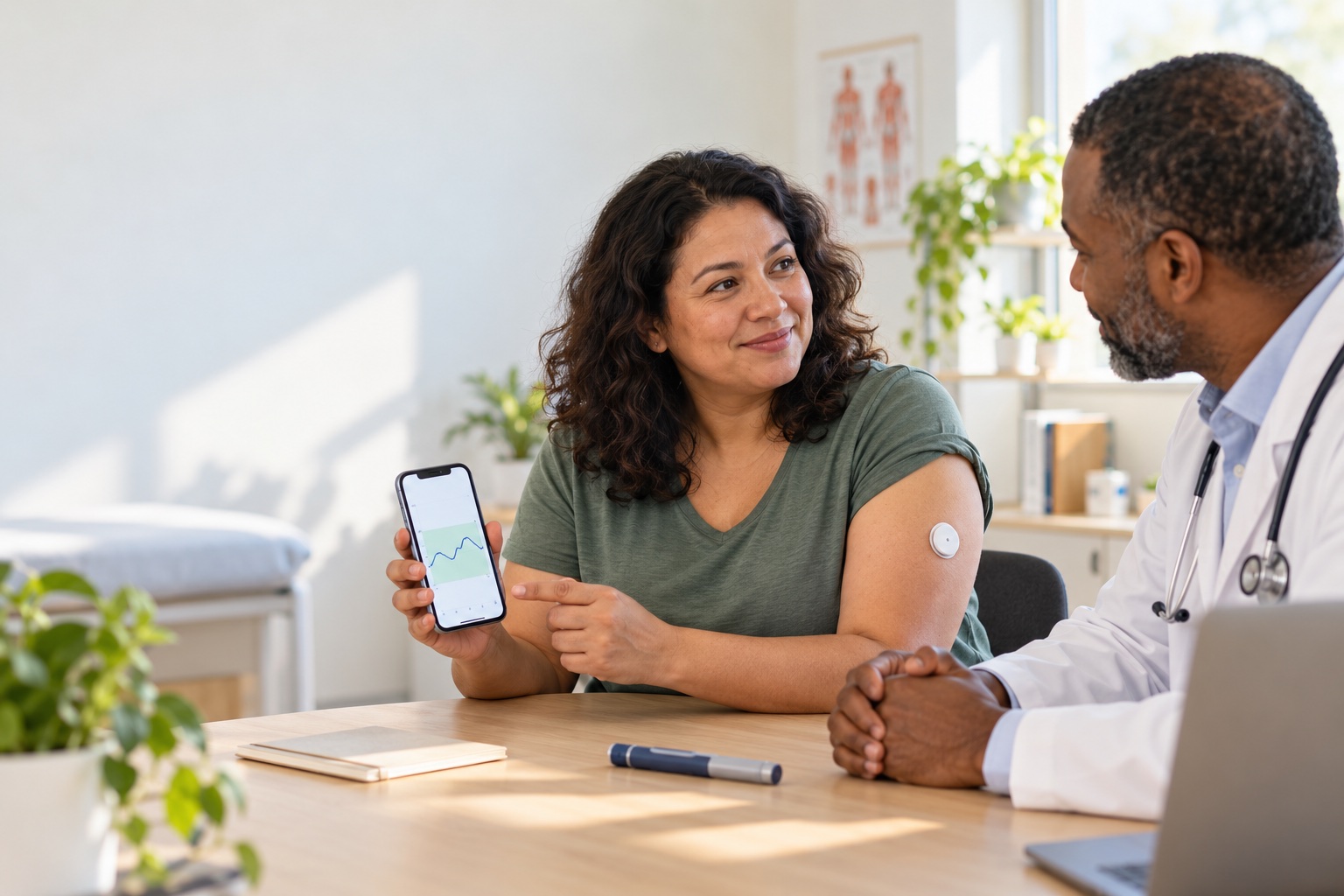
A new American Diabetes Association scientific statement says continuous glucose monitors, connected insulin pens and automated insulin delivery systems can be supported safely in primary care when clinics have the right training, workflows and access to specialist expertise.
That matters because many people receive most of their diabetes care from a family doctor or primary-care team rather than an endocrinologist. Better support in primary care could make diabetes technology easier to start, understand and continue using.
However, the statement is not a new randomized trial, and it does not say that every device is right for every person. It is an evidence-informed roadmap for healthcare systems and clinical teams. Its main message is that technology works best when it is matched to the individual and backed by education, follow-up and reliable access to data and supplies.
Key takeaways
- The statement covers continuous glucose monitoring, connected insulin pens and automated insulin delivery systems.
- It was developed by a 32-member interdisciplinary panel that reviewed evidence published from 2020 to 2025.
- The panel produced 16 consensus statements and 10 key recommendations for integrating diabetes technology into primary care.
- Successful services need trained staff, clearly defined roles, structured device onboarding and routine review of technology data.
- Primary care does not have to work alone. Diabetes educators, pharmacists, nurses and specialist teams can all contribute.
- Cost, insurance or health-system coverage, digital literacy, internet access and incompatible data systems can still prevent people from benefiting.
- A device is not a substitute for education, follow-up or an individual treatment plan.
What is a scientific statement?
A scientific statement summarises the available evidence and gives expert recommendations on an important area of care. It is different from a randomized clinical trial, which tests a specific treatment in a defined group of participants.
For this statement, the American Diabetes Association convened an interdisciplinary panel that met in October 2025 and reviewed research published between 2020 and 2025. The panel focused on access to technology, team-based care, continuous glucose monitoring, connected insulin delivery and the practical barriers facing primary-care services.
The result is guidance on how clinics can organise care. It does not provide one universal device choice, promise a particular reduction in HbA1c or prove that moving technology care into primary care will produce the same result in every health system.
Which diabetes technologies are included?
Continuous glucose monitoring
A continuous glucose monitor, or CGM, measures glucose in the fluid just beneath the skin. It can display current readings, trends and alerts on a receiver, smartphone or compatible insulin-delivery device.
CGM can help some people see patterns that are difficult to identify with occasional finger-stick checks. It can also create a large amount of information. People need support to understand trend arrows, alarms, time in range and situations in which a finger-stick confirmation may still be needed.
Connected insulin pens
Connected pens or pen attachments can record insulin doses and timing. Some systems combine this information with glucose data or a dosing application. They may help reduce missed-dose uncertainty, but they still depend on correct use, compatible devices and an agreed insulin plan.
Automated insulin delivery
Automated insulin delivery systems combine a CGM, an insulin pump and an algorithm that adjusts insulin delivery in response to glucose data. They are sometimes called hybrid closed-loop systems.
These systems can reduce some of the daily decision burden, but they are not fully automatic cures for diabetes. Users still need training, supplies, troubleshooting support and guidance for meals, exercise, illness, device failure and other situations.
Why primary care matters
Primary-care teams manage a large proportion of diabetes worldwide. Specialist services remain essential for many people, but access can be limited by geography, waiting times, cost or workforce shortages.
The new statement argues that appropriate technology support should not be restricted to specialist clinics. A prepared primary-care practice may be able to start or continue some technologies, review standard reports and identify when specialist input is needed.
This could be especially helpful for people with type 2 diabetes who use insulin, people who already use CGM but struggle to obtain routine data review, and people whose technology has been prescribed elsewhere but must be supported locally. The exact service will differ between countries, health systems and clinics.
What should a prepared clinic have in place?
The ADA highlights several practical foundations.
Training for the whole team
Training should not be limited to one clinician. Reception staff, nurses, pharmacists, doctors and diabetes educators may each handle different parts of prescriptions, prior authorisation, device setup, data uploads and follow-up.
Clearly defined responsibilities
People should know who to contact when a sensor fails, an alarm becomes difficult to manage, supplies run out or glucose patterns need clinical review. A clinic also needs a clear route for urgent problems and specialist referral.
Structured onboarding
Giving someone a device is not the same as helping them use it well. Onboarding may include fitting or activating the device, setting appropriate alerts, linking accounts, checking data-sharing permissions and teaching the person how to respond to common problems.
Routine data review
CGM, pump and connected-pen reports are useful only when they can be accessed and interpreted. Standardised reports can make patterns easier to review, but data must be considered alongside meals, activity, medicines, illness and the person’s own experience.
Access to specialist expertise
Primary care and specialist care should complement each other. Complex insulin needs, recurrent severe hypoglycaemia, pregnancy, advanced complications or difficulty using an automated system may require specialist support.
What might change for patients?
If the recommendations are adopted locally, people may be able to discuss a wider range of diabetes technology with their usual healthcare team. They may also receive more consistent help with setup, data interpretation and ongoing use.
A useful technology conversation should cover more than whether a device is available. It should consider:
- the person’s type of diabetes and treatment
- their goals and the problem the device is intended to solve
- comfort with wearing, charging and troubleshooting a device
- vision, hearing, dexterity, memory and language needs
- smartphone or receiver compatibility
- how data will be shared and reviewed
- the ongoing cost of sensors, infusion sets or other supplies
- what happens when the device fails or is temporarily unavailable
Not everyone wants or benefits from the same technology. Choosing not to use a device should not be treated as a failure, and people should be able to revisit the decision if their needs change.
Access remains a major issue
The statement places strong emphasis on equity. A device may be clinically suitable but remain inaccessible because of price, insurance rules, local funding, limited training or lack of compatible internet and digital systems.
Coverage rules vary widely. US insurance arrangements described by the ADA do not automatically apply in the UK, Europe, the Gulf region or other countries. Patients should check local eligibility and ongoing supply arrangements with their healthcare team or health system.
Digital literacy also matters. Some people need extra help with smartphones, account passwords, software updates or uploading data. Others may prefer a dedicated receiver rather than a phone. Services should adapt support rather than assuming everyone has the same technology skills or connectivity.
What the statement does not mean
- It does not mean every person with diabetes needs a CGM, connected pen or insulin pump.
- It does not mean every primary-care clinic is currently equipped to manage every device.
- It does not replace specialist diabetes care for people who need it.
- It does not guarantee that a particular device will be funded or covered.
- It does not support changing insulin doses or alarm settings without an agreed care plan.
- It does not remove the need for a backup plan when sensors, pumps, phones or internet connections fail.
Questions to ask your healthcare team
If you are interested in diabetes technology, consider asking:
- What problem could this device help me manage?
- Which options are suitable for my treatment and daily routine?
- Who will train me and help if I have problems?
- How often will my data be reviewed?
- What costs or supply limits should I expect?
- What information will be shared, and who can see it?
- What is my backup plan if the device stops working?
- When should I contact primary care, my diabetes team or emergency services?
Important safety points
Diabetes technology can support care, but safe use still requires an individual plan. Do not stop insulin, change doses or ignore symptoms solely because of a device reading.
If a glucose reading does not match how you feel, follow the manufacturer’s instructions and your clinical plan. This may include checking with a blood glucose meter. People using insulin pumps also need a plan for suspected interruption of insulin delivery, because glucose and ketone levels can rise quickly.
Urgent symptoms, severe hypoglycaemia, persistent very high glucose, vomiting or suspected ketoacidosis need prompt medical assessment according to your local emergency guidance.
Limitations of the statement
The recommendations are evidence-informed, but implementation research in primary care is still developing. Clinics differ in staffing, funding, prescribing rules, data systems and access to specialists. Technology also changes faster than many clinical studies can be completed.
The statement describes what health systems and practices should build. It does not prove that every proposed workflow improves long-term outcomes, and it cannot resolve local shortages or coverage restrictions by itself.
The bottom line
The new ADA scientific statement supports bringing well-organised diabetes technology care closer to where most people receive routine treatment. Its message is not simply to prescribe more devices. It is to create trained teams, clear workflows, reliable data review and fair access so that the right technology can be used safely by the right person.
For patients, that should mean a more practical conversation: what the technology could help with, whether it fits everyday life, who will provide support and what happens when something goes wrong.
Sources
- Ebekozien O, et al. Diabetes Technology in the Primary Care Setting: An American Diabetes Association Scientific Statement. Journal of Diabetes Science and Technology. Published online 28 September 2026. doi:10.1177/19322968261489568.
- American Diabetes Association. New ADA Scientific Statement: Diabetes Technology in Primary Care. 28 September 2026.
- American Diabetes Association Professional Practice Committee. Diabetes Technology: Standards of Care in Diabetes-2026. Diabetes Care. 2026;49(Suppl 1):S150-S165. doi:10.2337/dc26-S007.
- American Association of Clinical Endocrinology. Endorsed Clinical Guidance.
This article provides general education and is not individual medical advice. Speak with your diabetes or primary-care team before starting a new device or changing insulin, medicines or glucose-alert settings.