
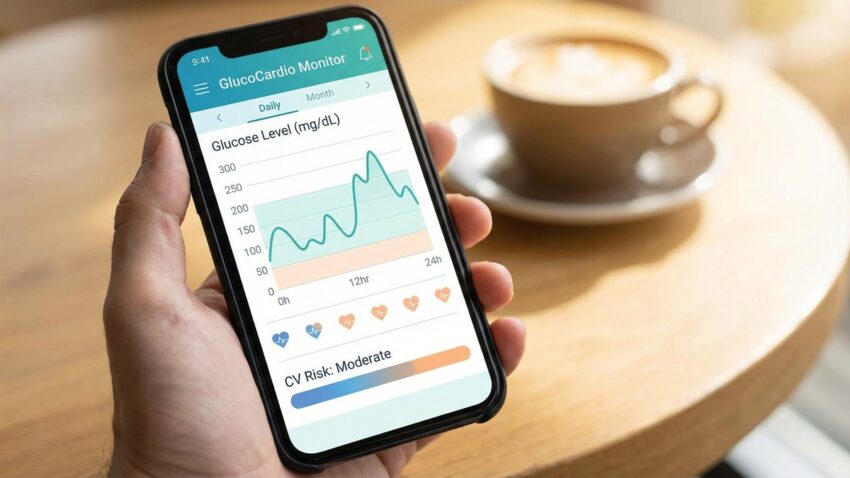
Continuous glucose monitoring (CGM) has transformed diabetes management by providing real-time glucose data that finger-prick testing cannot match. Beyond its immediate utility for dosing decisions, emerging research suggests that CGM-derived metrics — particularly glucose variability — may be powerful predictors of cardiovascular risk, offering insights that HbA1c alone cannot provide.
Beyond HbA1c: Why Glucose Variability Matters
HbA1c reflects average blood glucose over approximately three months, but it tells us nothing about the peaks and troughs that occur throughout the day. Two people with identical HbA1c values of 7% can have very different glucose profiles: one may have consistently stable glucose in the 6–8 mmol/L range, while the other oscillates between 3 and 15 mmol/L multiple times daily.
Research increasingly shows that this glucose variability — independent of average glucose — is associated with oxidative stress, endothelial dysfunction, and cardiovascular events. Each glucose spike triggers a burst of reactive oxygen species that damages the arterial endothelium, promotes inflammation, and activates coagulation pathways. The cumulative effect of repeated glucose excursions may explain why some people with “well-controlled” HbA1c still develop cardiovascular complications.
Key CGM Metrics and Their Cardiovascular Significance
| CGM Metric | Definition | Target | CV Significance |
|---|---|---|---|
| Time in Range (TIR) | % time between 3.9–10 mmol/L | >70% | Higher TIR associated with lower CV risk markers |
| Coefficient of Variation (CV) | Measure of glucose variability | <36% | High CV linked to oxidative stress and endothelial damage |
| Time Above Range (TAR) | % time above 10 mmol/L | <25% | Post-meal spikes drive inflammation and arterial stiffness |
| Time Below Range (TBR) | % time below 3.9 mmol/L | <4% | Hypoglycaemia triggers arrhythmias and sympathetic activation |
- Review your AGP (Ambulatory Glucose Profile) report with your diabetes team at each appointment
- Identify patterns of post-meal spikes and work on meal composition to reduce them
- Aim for Time in Range above 70% as a primary management target
- Address nocturnal hypoglycaemia — it triggers cortisol and adrenaline surges that stress the heart
- Use CGM data to optimise exercise timing and intensity for minimal glucose disruption
CGM provides a window into glucose dynamics that HbA1c cannot. Glucose variability — the peaks and troughs throughout the day — is an emerging cardiovascular risk factor in its own right. Focusing on Time in Range, reducing post-meal spikes, and eliminating hypoglycaemia are strategies that benefit both short-term glucose management and long-term cardiovascular health.
 English
  Urdu
Urdu