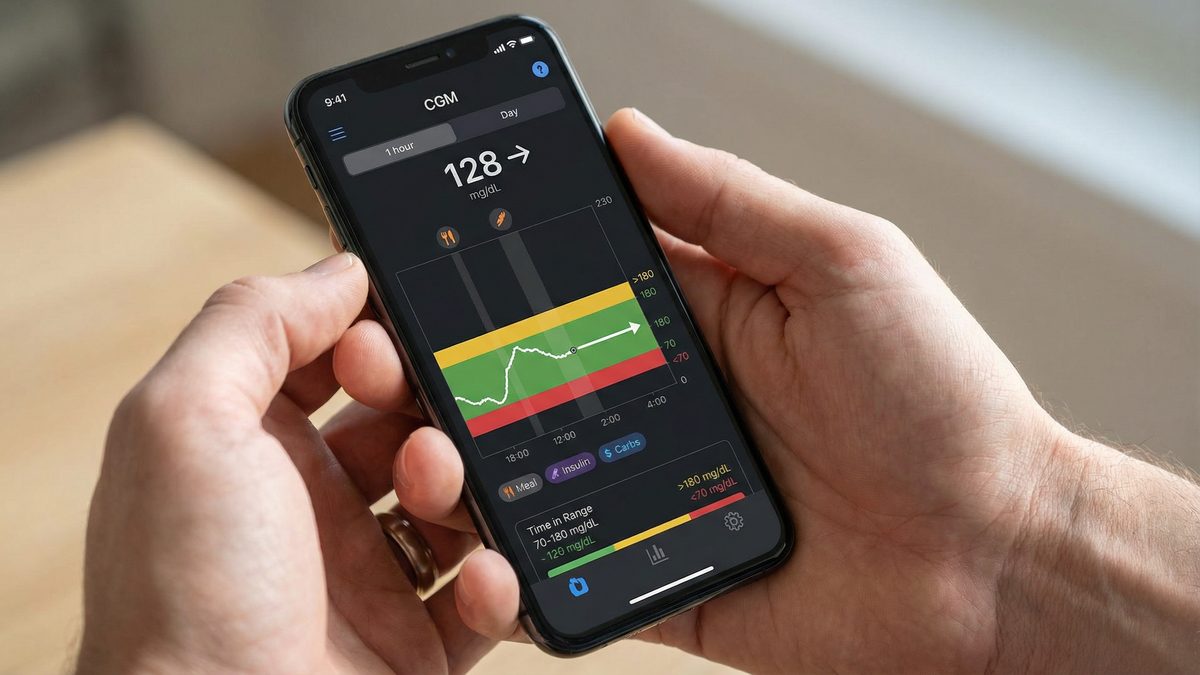
CGM graphs can make diabetes patterns visible, but they can also feel overwhelming. The goal is not to judge every line. The goal is to find patterns that can make care safer and more practical.
Quick summary
A useful CGM review looks at time in range, time below range, time above range, overnight patterns, meal patterns, and whether readings match symptoms.
Key takeaways
- Time in range shows the percentage of time glucose spent within the target range set for you.
- Time below range is a safety priority because hypoglycemia can be dangerous.
- Single spikes are less useful than repeated patterns.
- CGM data should be reviewed with medicines, meals, activity, sleep, illness, and stress.
Parts of the graph
- Daily trace: the line showing glucose movement through the day.
- Time in range: how often readings were in the target range.
- Time below range: how often readings were low.
- Time above range: how often readings were high.
- Trend arrows: whether glucose is rising, falling, or steady.
How to use patterns
Look for repeatable moments: overnight lows, morning highs, post-meal rises, exercise-related drops, or late-day swings. Then ask what might explain them.
Do not change medicine from a graph alone unless that is part of your care plan. The safest review combines data with symptoms, food, medicine timing, and clinician guidance.
Practical takeaway
Read CGM graphs for patterns, not blame. The most useful question is: what repeated pattern can we make safer?
Safety note
This article is not a substitute for medical care. Seek urgent care for severe low blood sugar, confusion, seizure, ketones with illness, repeated vomiting, or symptoms that feel unsafe.
What to ask your care team
- What is my personal time-in-range goal?
- Which pattern is most important to fix first?
- When should I confirm CGM readings with a fingerstick?
Related reading
Source summary
- Continuous Glucose Monitoring, National Institute of Diabetes and Digestive and Kidney Diseases. Patient guidance. Accessed June 5, 2026. Source
- Diabetes Testing, Centers for Disease Control and Prevention. Patient guidance. Accessed June 5, 2026. Source
- Low Blood Sugar, Centers for Disease Control and Prevention. Patient guidance. Accessed June 5, 2026. Source
- Insulin, Medicines, and Other Diabetes Treatments, National Institute of Diabetes and Digestive and Kidney Diseases. Patient guidance. Accessed June 5, 2026. Source