
Managing insulin resistance is a critical step in preventing type 2 diabetes and improving overall metabolic health. Two popular dietary approaches, the low-carbohydrate diet and the ketogenic (keto) diet, have gained significant attention for their potential benefits. Both strategies involve restricting carbohydrate intake, but they differ in their macronutrient composition and physiological effects. Understanding these differences is key to choosing the right approach for your health goals.
## Understanding Insulin Resistance
Insulin is a hormone that helps your cells absorb glucose from the bloodstream for energy. When you have insulin resistance, your cells don’t respond effectively to insulin, leading to higher blood sugar levels. Over time, this can lead to prediabetes and eventually type 2 diabetes. A primary driver of insulin resistance is often a diet high in refined carbohydrates and sugars, which can lead to chronically elevated insulin levels [1].
## The Low-Carbohydrate Approach
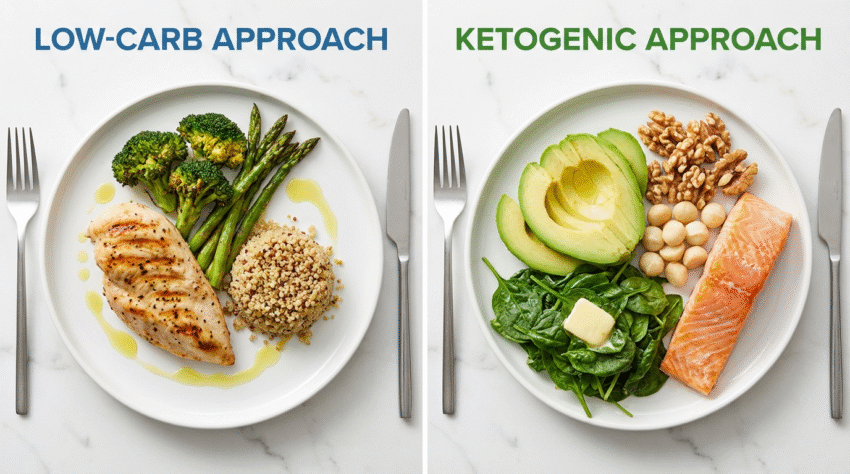
A low-carbohydrate diet limits sugary foods, pasta, and bread, but is less restrictive than a ketogenic diet. There isn’t a strict definition, but low-carb diets typically restrict carbohydrate intake to between 50 and 150 grams per day. The focus is on consuming whole, unprocessed foods, including non-starchy vegetables, lean proteins, and healthy fats.
By reducing carbohydrate intake, a low-carb diet helps lower blood sugar and insulin levels. This can improve insulin sensitivity, as the body is not constantly working to manage high glucose levels. Research has shown that low-carb diets can be effective for weight loss and improving glycemic control in individuals with insulin resistance [2].
| Feature | Low-Carbohydrate Diet | Ketogenic Diet |
| :— | :— | :— |
| **Daily Carbs** | 50-150 grams | < 50 grams (often < 20g) |
| **Primary Goal** | Reduce blood sugar and insulin | Induce and maintain ketosis |
| **Protein Intake** | Moderate to high | Moderate |
| **Fat Intake** | Moderate to high | Very high (70-80% of calories) |
| **Flexibility** | More flexible, wider food choices | Very restrictive |
## The Ketogenic Diet: A Stricter Approach
The ketogenic diet is a very low-carbohydrate, high-fat diet. The goal of the keto diet is to shift the body's primary fuel source from glucose to ketones, which are produced by the liver from fat. This metabolic state is called **ketosis**. To achieve ketosis, carbohydrate intake is typically restricted to fewer than 50 grams per day, and often as low as 20 grams.
For individuals with insulin resistance, the keto diet can be highly effective. The drastic reduction in carbohydrates leads to a significant decrease in blood sugar and insulin levels. Several studies have demonstrated that a ketogenic diet can lead to substantial improvements in insulin sensitivity, weight loss, and glycemic control [3] [4]. Some research even suggests that the state of ketosis itself may have beneficial effects on insulin receptor sensitivity [5].
## Key Differences and Considerations
The main difference between a low-carb and a keto diet is the degree of carbohydrate restriction and the resulting metabolic state. While both can be effective, there are several factors to consider:
* **Sustainability:** The keto diet is highly restrictive, which can make it difficult to follow long-term. A more moderate low-carb diet may be a more sustainable option for many people.
* **Nutrient Deficiencies:** The restrictive nature of the keto diet can increase the risk of nutrient deficiencies if not carefully planned. It's important to focus on nutrient-dense, low-carb foods.
* **Side Effects:** The initial transition to a keto diet can cause side effects known as the "keto flu," which can include headaches, fatigue, and nausea. These symptoms are usually temporary.
* **Medical Supervision:** Due to its restrictive nature, it is often recommended to undertake a ketogenic diet under the guidance of a healthcare professional, especially for individuals with pre-existing health conditions.
## Which Diet is Right for You?
Both low-carb and ketogenic diets can be powerful tools for managing insulin resistance. The best choice depends on your individual health status, lifestyle, and preferences.
For many, starting with a moderate low-carb diet is a practical and effective first step. It allows for more dietary flexibility and is generally easier to sustain. If a more aggressive approach is needed, or if you are looking for more rapid results, a well-formulated ketogenic diet may be a suitable option, ideally with professional guidance.
Ultimately, the most effective diet is one that you can stick with consistently. Focusing on whole, nutrient-dense foods and reducing your intake of processed carbohydrates and sugars is a fundamental principle that applies to both approaches and is the cornerstone of improving insulin sensitivity.
### References
[1] American Diabetes Association. (n.d.). *Carbs and Diabetes*. [https://diabetes.org/food-nutrition/understanding-carbs](https://diabetes.org/food-nutrition/understanding-carbs)
[2] Wheatley, S. D., et al. (2021). *Low Carbohydrate Dietary Approaches for People With Type 2 Diabetes*. PMC. [https://pmc.ncbi.nlm.nih.gov/articles/PMC8319397/](https://pmc.ncbi.nlm.nih.gov/articles/PMC8319397/)
[3] Paoli, A., et al. (2023). *The Effects of Ketogenic Diet on Insulin Sensitivity and Weight Loss*. PMC. [https://pmc.ncbi.nlm.nih.gov/articles/PMC10385501/](https://pmc.ncbi.nlm.nih.gov/articles/PMC10385501/)
[4] Yuan, X., et al. (2020). *Effect of the ketogenic diet on glycemic control, insulin resistance, and lipid metabolism in patients with type 2 diabetes*. Nature. [https://www.nature.com/articles/s41387-020-00142-z](https://www.nature.com/articles/s41387-020-00142-z)
[5] Bolla, A. M., et al. (2019). *Low-carb and ketogenic diets in type 1 and type 2 diabetes*. Nutrients. [https://www.mdpi.com/2072-6643/11/5/962](https://www.mdpi.com/2072-6643/11/5/962)

