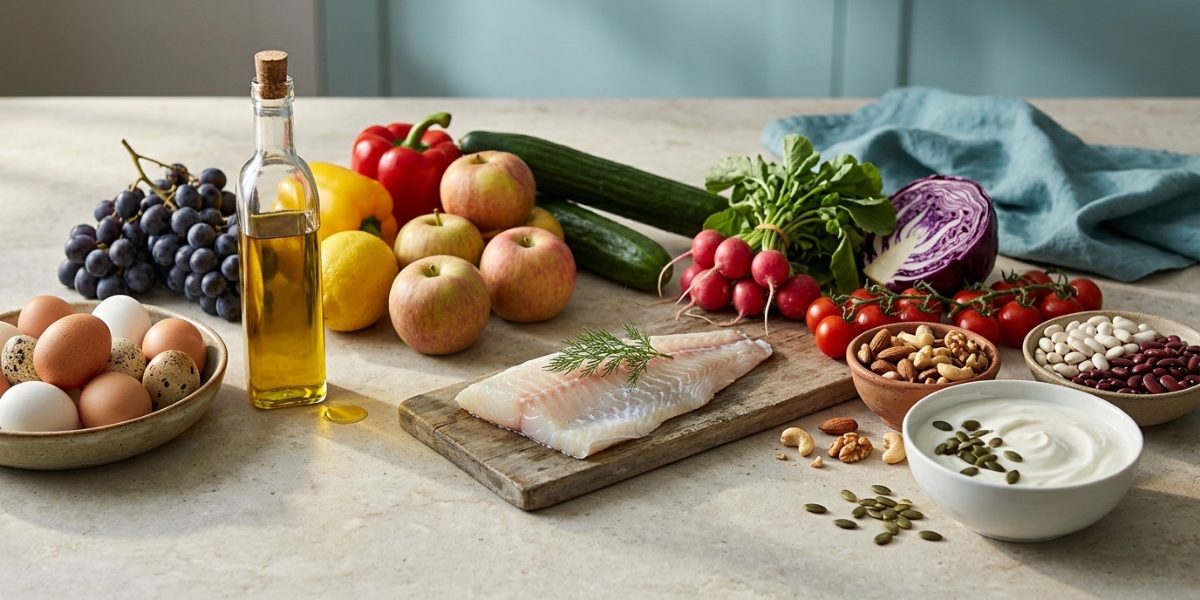
The short answer
The 2025 to 2030 Dietary Guidelines for Americans, released in January 2026, say eat real food: fewer highly processed foods, much less added sugar and fewer refined carbs.
Much of it lines up with good diabetes eating. But the saturated fat limit hasn’t changed, and the higher protein goal isn’t right for everyone, especially with kidney disease.
The US published new dietary guidelines in January 2026, with the slogan “eat real food” and a new upside-down food pyramid. Here’s what changed and what’s useful if you have diabetes.
What changed?
| Topic | 2025 to 2030 guidelines | Before |
|---|---|---|
| Processed food | Cut highly processed foods, sugary drinks and packaged sweet or salty snacks | Not named as a category |
| Added sugar | No amount recommended; no meal over 10 g | Under 10% of calories (about 50 g a day) |
| Children | No added sugar until age 10 | Until age 2 |
| Protein | 1.2 to 1.6 g per kg body weight a day | Lower minimum (0.8 g/kg) |
| Grains | 2 to 4 servings a day, mostly whole grain; much less refined carb | More grain servings |
| Dairy | 3 servings a day, full-fat allowed, no added sugar | Low-fat preferred |
| Saturated fat | Under 10% of calories | Unchanged |
What’s useful for diabetes?
- Less added sugar and refined carbs. This is the biggest win for glucose. Sugary drinks, white bread and sweets raise blood sugar fastest.
- Less highly processed food. Whole foods tend to have more fibre and less hidden sugar and salt.
- Whole grains over refined. Fewer servings, better quality.
- Protein at meals. It fills you up and has little direct effect on glucose.
Most of this matches what diabetes guidelines already advise.
What needs care?
- Saturated fat. The pyramid shows steak, butter and full-fat dairy prominently, but the limit of under 10% of calories hasn’t moved. Experts at Harvard warned the mixed message could push saturated fat and LDL cholesterol up. Diabetes already raises heart risk, so olive oil, nuts, seeds and oily fish are still the better fats.
- Protein. 1.2 to 1.6 g/kg isn’t right for everyone. If you have kidney disease, your target is usually lower. Ask your kidney team. See how much protein you need.
- Protein sources. The guidance doesn’t say which to choose more often. Beans, lentils, fish and poultry are better day-to-day choices than red and processed meat.
- Not a diabetes plan. These are for the general US public. Your carb amounts and medicines still need individual advice.
What does “real food” look like?
| Real food | Highly processed version |
|---|---|
| An apple | Apple juice |
| Chicken breast | Chicken nuggets |
| Porridge oats | Flavoured instant oat sachets |
| Plain yoghurt with berries | Fruit-flavoured yoghurt |
| Homemade lentil soup | Instant noodle pot |
I’m in the UK. Does this apply?
Not officially. The UK still uses the Eatwell Guide. But cutting added sugar and processed food is good advice anywhere.
The bottom line
Eat real food, cut sugar and refined carbs, and keep an eye on saturated fat. That’s a sound pattern for diabetes. For a ready-made version, see the Mediterranean diet or the plate method.
Sources
- US Department of Agriculture and Department of Health and Human Services. Dietary Guidelines for Americans 2025 to 2030.
- Harvard T.H. Chan School of Public Health, The Nutrition Source. Dietary Guidelines for Americans 2025 to 2030: progress on added sugar, protein hype, saturated fat contradictions.
- American Diabetes Association. Standards of Care in Diabetes 2026, section 5: Facilitating positive health behaviors and well-being.
General public information, not personalised treatment advice. Children, pregnancy and complex health conditions need individual specialist advice. Don’t start, stop or change a medicine without speaking to your own healthcare team.