The short answer
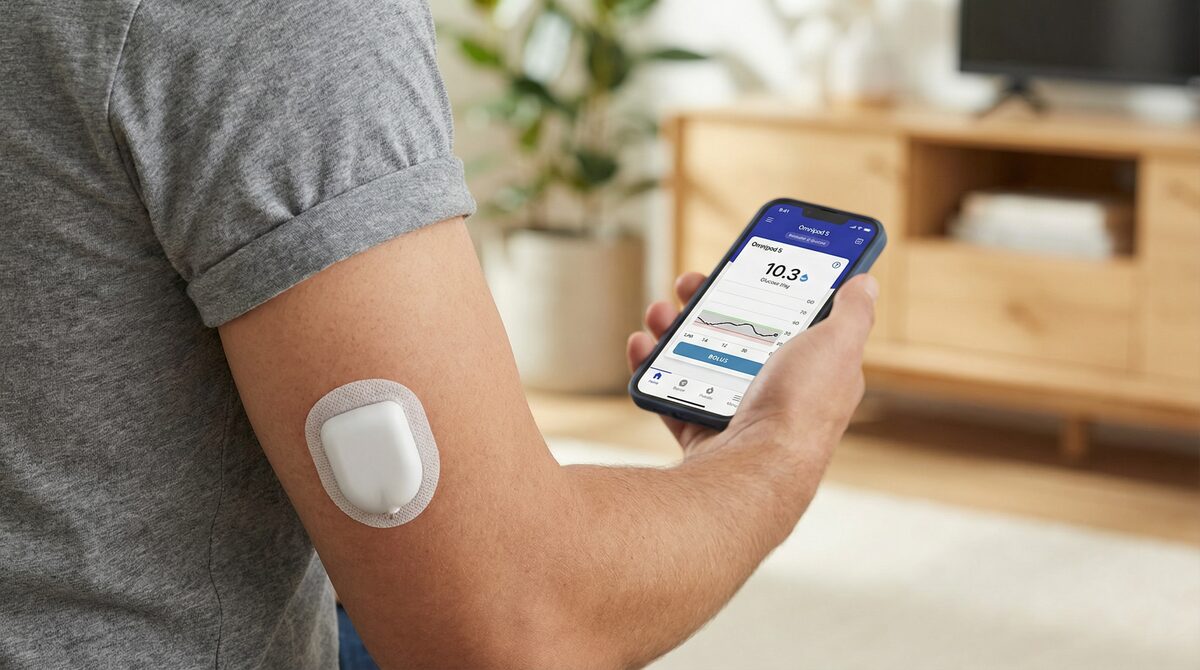
Omnipod 5 is a tubeless insulin pump that sticks to the skin and links to a glucose sensor. Every 5 minutes it predicts your glucose an hour ahead and raises, lowers or pauses insulin. You still give doses for meals.
It’s approved for type 1 diabetes from age 2 and type 2 diabetes in adults. Pods are changed every 3 days. It isn’t a cure, and it only works well with training, carb counting and a working sensor.
Here’s how it works, who it’s for, and what to think about first.
What is Omnipod 5?
An automated insulin delivery system, sometimes called a hybrid closed loop. It has three parts:
- The Pod. A small insulin pump stuck to your skin, with no tubing. It holds up to 200 units of rapid-acting insulin and is changed every 3 days.
- A glucose sensor. Compatible sensors include Dexcom G7 and FreeStyle Libre 2 Plus and 3 Plus.
- The app or controller. On a compatible phone or a handset from Insulet. This is where you give meal doses and see your data.
How does the automatic part work?
The software is called SmartAdjust and it lives in the Pod itself. It uses your sensor reading and which way it’s heading to predict where glucose will be in up to 60 minutes. Then, every 5 minutes, it increases, decreases or pauses insulin.
You choose a target glucose between 100 and 150 mg/dL, about 5.6 to 8.3 mmol/L. An Activity setting lets the system aim higher and give less insulin around exercise.
What it doesn’t do: count your carbs. You still tell it about meals, and the built-in calculator suggests a dose.
Who is it for?
The maker lists it for type 1 diabetes from age 2, and type 2 diabetes from age 18. It isn’t for people who need less than 5 units of insulin a day.
US guidance now says automated insulin delivery is the preferred way to give insulin for people with type 1 diabetes, and for adults with type 2 diabetes who need it. It also says nobody should have to prove a set C-peptide level or length of time on insulin first.
In England, NICE recommends hybrid closed loop systems for people with type 1 diabetes who have an HbA1c of 58 mmol/mol (7.5%) or more, or disabling hypos, despite their best efforts. Children and young people, and those who are pregnant or planning pregnancy, can have one whatever their HbA1c.
What are the upsides?
- No tubing to catch on doors or tangle at night.
- Steadier overnight glucose, because the system adjusts while you sleep.
- Fewer injections. One pod change every 3 days instead of several jabs a day.
- The Pod is water resistant. Insulet rates it to 25 feet for an hour. The controller isn’t.
What are the downsides?
- You still have to bolus for meals. Missed meal doses are still the biggest cause of high readings.
- A blocked or dislodged Pod means no insulin. Because pumps use only rapid-acting insulin, glucose and ketones can rise within hours. Always carry insulin pens or syringes as backup.
- Sensor problems switch off the automatic part. Without sensor data it falls back to preset rates.
- Skin. Some people react to adhesives. US guidance says skin reactions should be looked at and dealt with, because they’re a common reason people stop.
- Waste and cost. Every pod is thrown away after use, and supplies depend on your health system.
How does it compare with tubed pumps?
The big difference is the tubing. Tubed pumps, like the Tandem t:slim X2, hold more insulin and the pump itself is reused for years. Omnipod 5 is lighter to wear and simpler to put on.
See Tandem t:slim X2 with Control-IQ for the tubed alternative.
What should I ask before choosing it?
- Is it available through my clinic, and which sensors does my clinic supply?
- What training will I get, and who do I call at 2 a.m. if a Pod fails?
- Will my phone work with the app, or do I need the handset?
- What’s my plan if I run out of pods while travelling?
The bottom line
Omnipod 5 adjusts insulin for you every 5 minutes without tubing. It takes a lot of the overnight work away. It doesn’t take away meal doses, pod changes or the need for a backup plan.
The overview is in our type 1 diabetes guide. For dose basics, see basal and bolus insulin explained.
Sources
- Insulet. Omnipod 5 automated insulin delivery system.
- American Diabetes Association. Standards of Care in Diabetes 2026, section 7: Diabetes technology.
- NICE technology appraisal TA943. Hybrid closed loop systems for managing blood glucose levels in type 1 diabetes.
General public information, not personalised treatment advice. Children, pregnancy and complex health conditions need individual specialist advice. Don’t start, stop or change a medicine without speaking to your own healthcare team.