The short answer
Screens don’t raise blood sugar by themselves. The risk comes from what long screen time does: hours of sitting, and late nights in bright light.
In large studies, every extra 2 hours a day of TV was linked to a 20% higher risk of type 2 diabetes, and brighter nights to a higher risk too. Break up sitting every 30 minutes and keep the bedroom dark.
Here’s what the research shows, and what’s worth changing.
Is it the screen or the sitting?
Mostly the sitting.
When you sit still for long stretches, your big leg muscles barely use any sugar. Blood sugar after a meal stays higher for longer. Over years, that adds to insulin resistance.
Screens just happen to be what most of us sit in front of. TV, gaming, scrolling, long hours at a desk.
How big is the risk?
A review of four large studies, covering about 176,000 people, looked at TV time and type 2 diabetes.
| Every extra 2 hours of TV a day | Linked with |
|---|---|
| Type 2 diabetes | 20% higher risk |
| Heart disease | 15% higher risk |
| Death from any cause | 13% higher risk |
In real numbers, the authors estimated about 176 extra cases of type 2 diabetes for every 100,000 people a year, per 2 hours.
These studies can’t prove the TV caused it. People who watch a lot may also snack more and move less. But the link was steady: more hours, more risk.
Does light at night matter?
It seems to. In a UK study, about 85,000 people wore a light sensor on their wrist for a week. They were then followed for around 8 years.
Compared with people whose nights were dark, those with the brightest nights had a 53% higher risk of type 2 diabetes. That held after allowing for age, lifestyle and genetic risk.
The likely reason is the body clock. Light at night tells your brain it’s still daytime, which upsets the timing of hormones that handle sugar. It also cuts into sleep.
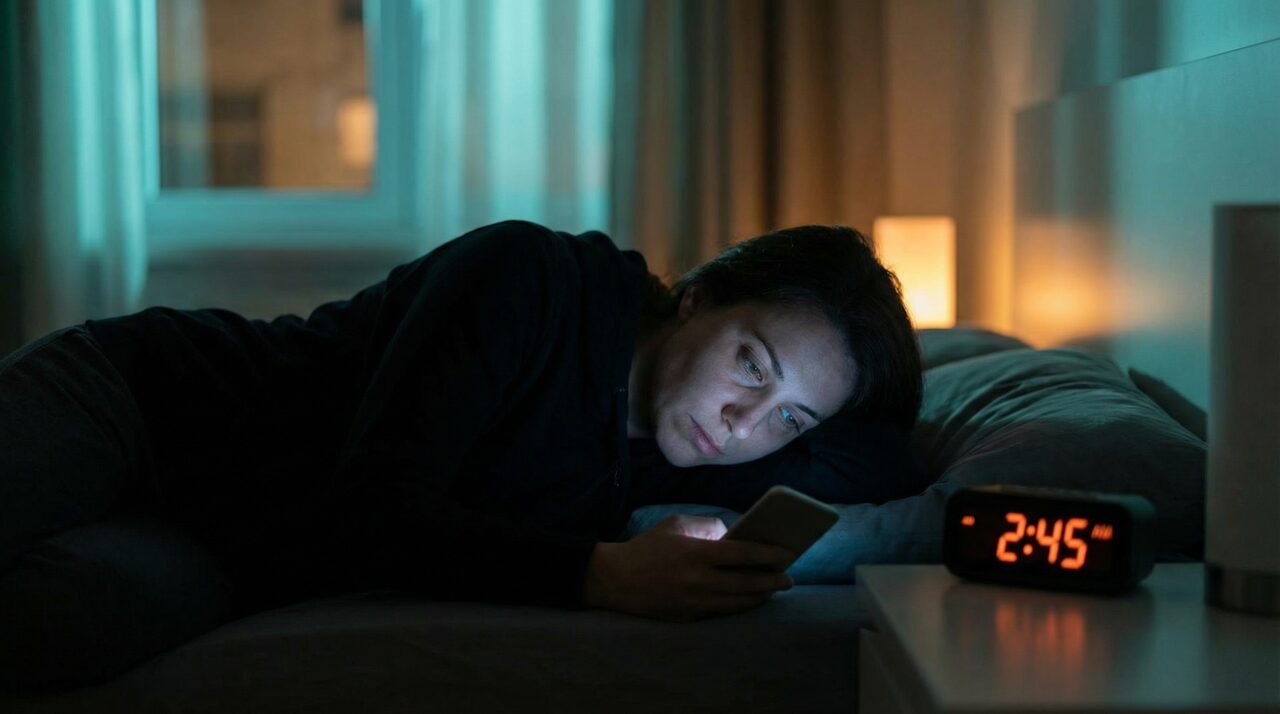
A phone in bed is one source of that light. Overhead lights, TVs and streetlights are others.
What about blue light specifically?
Screens give off a lot of blue light, which is the type that most strongly delays sleep. So yes, it plays a part.
But dimming the screen or using night mode doesn’t fix the bigger problems. You’re still sitting, still awake, and still not asleep. Putting the screen down does more.
And sleep?
Late screens push bedtime later and make sleep lighter. Short or broken sleep raises blood sugar on its own.
There’s more on that in how sleep affects blood sugar.
What should I change?
US diabetes guidance says to break up sitting every 30 minutes and to put devices on silent or off at night. Practical ways to do that:
- Set a 30-minute timer while you work or watch. Stand, stretch, walk to the kitchen.
- Move during the gaps. Stand up between episodes or during adverts.
- Walk your calls. Phone calls don’t need a chair.
- A 10-minute walk after meals blunts the sugar rise more than the same walk at another time.
- Stop screens a while before bed, and keep phones out of the bedroom if you can.
- Make the bedroom dark. Thick curtains, no TV, standby lights covered.
If you wear a sensor or pump, keep its alerts on. That’s the one device that should stay awake.
What about children?
The same principles apply. Long screen time in children tends to replace active play and push bedtime later.
Agreed screen-free times, especially the hour before bed, and screens out of bedrooms, are a good start.
The bottom line
Screen time isn’t poison. Hours of sitting and late, bright nights are the problem.
Get up every half hour. Keep the bedroom dark. Those two habits do most of the work.
More on lowering your risk in what prediabetes is and whether it can be reversed, and in our type 2 diabetes guide.
Sources
- Grøntved A, Hu FB. Television viewing and risk of type 2 diabetes, cardiovascular disease, and all-cause mortality: a meta-analysis. JAMA, 2011.
- Windred DP and colleagues. Personal light exposure patterns and incidence of type 2 diabetes. The Lancet Regional Health Europe, 2024.
- American Diabetes Association. Standards of Care in Diabetes 2026, section 5: Facilitating positive health behaviors and well-being.
General public information, not personalised treatment advice. Children, pregnancy and complex health conditions need individual specialist advice. Don’t start, stop or change a medicine without speaking to your own healthcare team.