The short answer
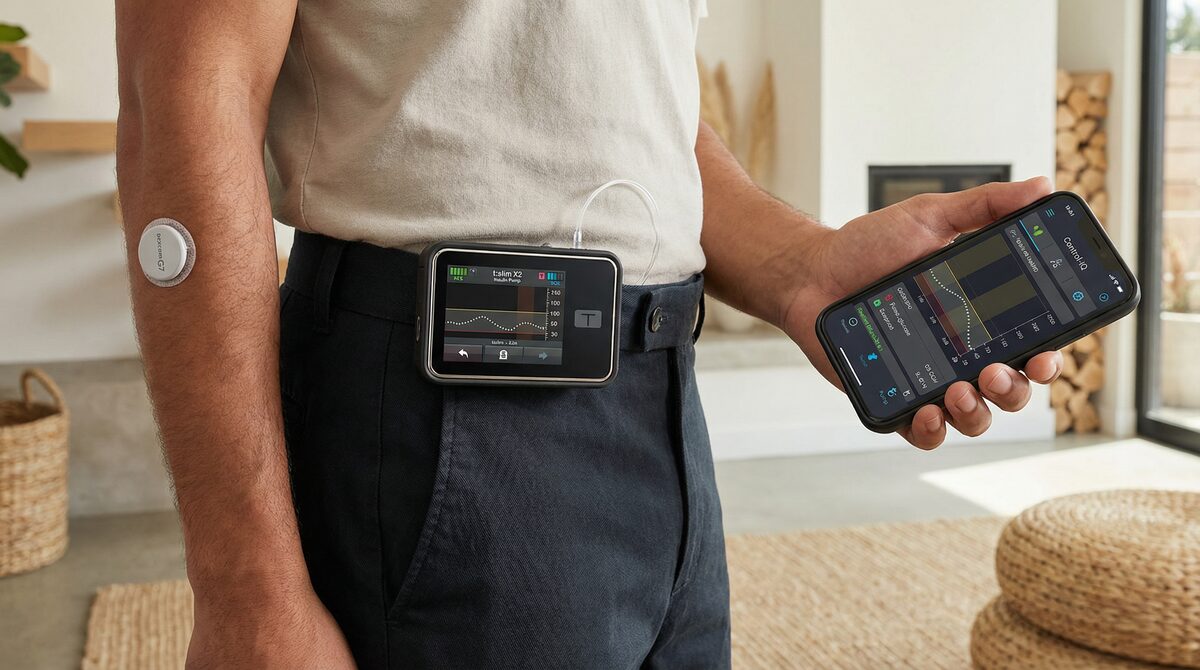
The t:slim X2 is a tubed insulin pump with a touchscreen. Its Control-IQ software reads a glucose sensor, predicts levels 30 minutes ahead, and adjusts insulin every 5 minutes. It can also give small automatic correction doses, up to once an hour.
You still dose for meals. It suits people who want automation and are happy wearing a pump with tubing. A blocked set means no insulin, so backup pens and ketone checks are essential.
Here’s what the software actually does, and what to weigh up.
What is it?
The t:slim X2 is a small rechargeable insulin pump with a colour touchscreen. Insulin goes through thin tubing to a cannula under the skin. The pump talks to a glucose sensor, and Control-IQ is the software that adjusts the insulin.
Tandem also makes a smaller pump, Tandem Mobi, which runs the same software.
How does Control-IQ decide what to do?
It uses the sensor reading to predict your glucose 30 minutes ahead, then adjusts insulin every 5 minutes. Tandem gives these thresholds:
| Predicted glucose in 30 minutes | What Control-IQ does |
|---|---|
| Above 8.9 mmol/L (160 mg/dL) | Increases background insulin |
| Above 10.0 mmol/L (180 mg/dL) | Can give an automatic correction dose, up to once an hour |
| Below 6.25 mmol/L (112.5 mg/dL) | Reduces background insulin |
| Below 3.9 mmol/L (70 mg/dL) | Stops background insulin |
The automatic correction is the feature people notice most. If you forget a meal dose or underestimate carbs, it chips away at the high. It won’t fully replace a proper meal dose, though.
There are also Sleep and Exercise settings that change how hard it pushes.
Who is it for?
Mainly people with type 1 diabetes on insulin, and more and more people with type 2 diabetes who need several insulin doses a day. Licensed ages and sensor options vary by country, so check with your clinic.
US guidance says automated insulin delivery is now the preferred way to give insulin in type 1 diabetes, and for adults with type 2 diabetes who need it.
In England, NICE recommends hybrid closed loop systems for people with type 1 diabetes whose HbA1c is 58 mmol/mol (7.5%) or more, or who have disabling hypos. Children, young people, and people who are pregnant or planning pregnancy can have one whatever their HbA1c.
What are the upsides?
- Fewer highs and lows, especially overnight.
- Automatic corrections for the meals you misjudge.
- The pump is rechargeable and reused, and the cartridge holds more insulin than a patch pump.
- Many people can give meal doses from their phone.
What are the downsides?
- Tubing. It can catch on handles and get pulled out. Some people hate it, some don’t notice.
- Infusion set problems. A kinked or blocked set means no insulin. Glucose and ketones can climb within hours, because pumps only use fast-acting insulin.
- Sensor dependence. No sensor data, no automation.
- Not waterproof enough to swim with for long. Most people disconnect for swimming and showers. Check your model’s rating.
What safety rules matter most?
- Carry backup. Insulin pens or syringes, a spare set, and your long-acting dose written down in case the pump fails.
- Unexplained high? Check for ketones. If they’re up, give a correction by pen, not the pump, and change the set.
- Know DKA warning signs. See when high blood sugar needs hospital.
- Keep a meter. US guidance says people using sensors should always have access to finger-prick testing too.
How does it compare with Omnipod 5?
| t:slim X2 with Control-IQ | Omnipod 5 | |
|---|---|---|
| Tubing | Yes | No |
| Prediction window | 30 minutes | Up to 60 minutes |
| Automatic corrections | Yes, up to once an hour | Adjusts background insulin only |
| Pump | Rechargeable, reused | Disposable pod every 3 days |
More on the tubeless option: Omnipod 5.
The bottom line
Control-IQ does a lot of the minute-to-minute work and catches some of the highs you miss. It still needs you for meals, set changes and a backup plan.
The overview is in our type 1 diabetes guide.
Sources
- Tandem Diabetes Care. Impact of treatment values on Control-IQ technology.
- Tandem Diabetes Care. Control-IQ technology.
- American Diabetes Association. Standards of Care in Diabetes 2026, section 7: Diabetes technology.
- NICE technology appraisal TA943. Hybrid closed loop systems for managing blood glucose levels in type 1 diabetes.
General public information, not personalised treatment advice. Children, pregnancy and complex health conditions need individual specialist advice. Don’t start, stop or change a medicine without speaking to your own healthcare team.