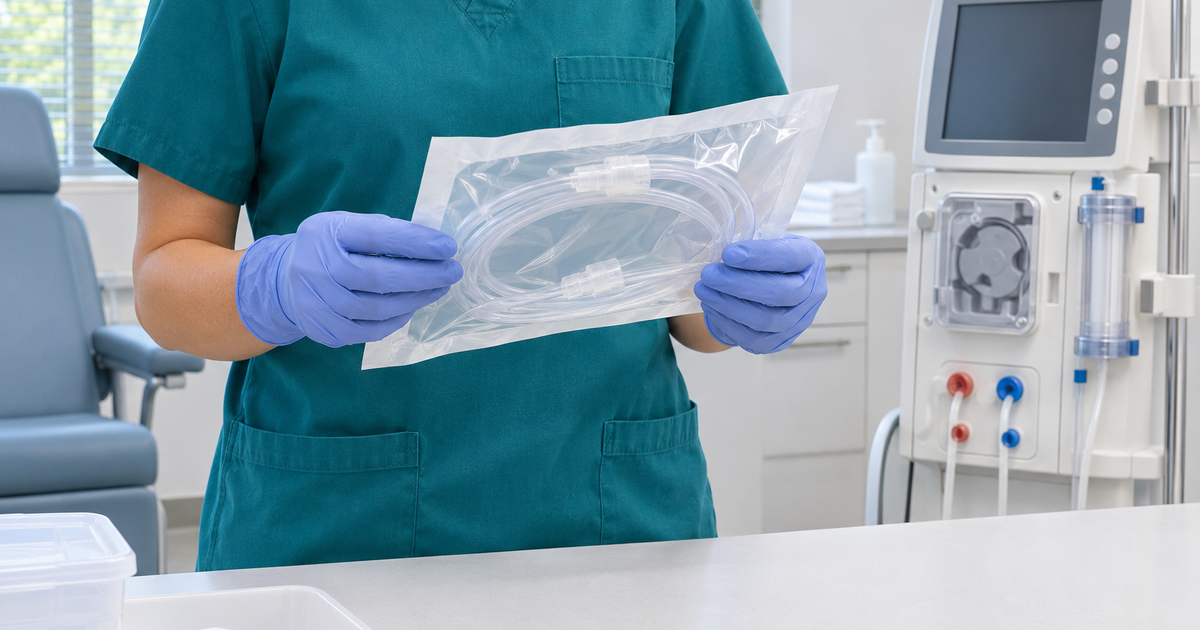
Illustrative dialysis equipment check, not the recalled product or packaging.
The US Food and Drug Administration has posted an Early Alert about three lots of B. Braun Streamline bloodline sets used with the Dialog+ haemodialysis system. A connector may detach or leak because of inadequate bonding during manufacture. The advice for the affected stock is to stop using it, quarantine it and return it to the manufacturer.
This is a specific equipment alert, not a recommendation to stop dialysis. People receiving treatment should ask their dialysis team to check the product and lot numbers and arrange suitable equipment. The FDA communication is dated 2 November 2026 and refers to a customer letter sent on 20 October.
Which Bloodline Sets Are Affected?
The FDA lists the following identifiers for this alert:
- Product: Streamline Bloodline Set for Dialog+.
- Model: SL-2010M2096.
- UDI-DI identifiers: 04046964367786 and 04046964367779.
- Affected lots: A2600099, A2600128 and A2600136.
A model name alone is not enough to identify the stock covered by this particular notice. Staff need to compare the lot and device identifiers with the supplied packaging and current manufacturer instructions. Do not assume that every dialysis machine, every bloodline set or every product carrying the B. Braun name is included.
The FDA notice is directed at the US market. A dialysis service outside the US should also check its own supplier and national safety notices rather than assume that the same distribution or product list applies everywhere.
What Is the Manufacturing Problem?
According to the FDA, B. Braun reported that a required solvent-application step was not performed during assembly. That left an inadequately bonded dialyser connector. The connection may separate or leak while the equipment is being prepared or during dialysis.
Blood normally travels through tubing to an external filter, called a dialyser, and then returns to the body. A leak or separation in that circuit can cause blood loss. It can also lead to clotting or blockage of the circuit and interruption of treatment while the bloodline is replaced.
The FDA warns that significant blood loss can be life-threatening. An inadequately bonded connection may also allow air into the blood circuit. Although the dialysis machine’s air-detection system is expected to detect this, the notice describes a rare possibility of air passing the detector and causing an air embolism, which can be fatal.
Have Injuries Been Reported?
The FDA communication says that, as of 10 October 2026, B. Braun had reported no serious injuries or deaths associated with this issue. That statement has a specific reporting date. It is not a guarantee that no later event has occurred, nor does it mean an affected set is safe to use.
The notice does not provide a usable probability of harm for an individual treatment. Potential severity and the absence of reported harm are different things. The action for the identified lots remains the removal instruction in the notice.
What Are Dialysis Services Being Asked to Do?
The customer letter described by the FDA asks services to inform users and other relevant people, identify affected inventory, stop using it, quarantine it and return it to the manufacturer. Distributors are asked to forward the notice to their customers.
These are equipment and stock-control actions for the dialysis service and its supply chain. They are not instructions for patients to disconnect tubing, repair a connector or substitute a different set themselves. An apparently intact connection does not override the recall instruction.
US customers with questions, quality problems or adverse reactions can contact B. Braun using the details in the FDA notice: recalls@bbraunusa.com or (610) 849-1197. The FDA also accepts device problem reports through MedWatch.
What Can Patients and Care Partners Ask?
- Does this dialysis service use model SL-2010M2096?
- Have the three listed lots been checked and removed from use?
- Who should I contact if I have affected supplies at home?
- How will the team arrange safe equipment without an unplanned interruption to my care?
If you use home haemodialysis and recognise an affected supply, contact your dialysis service promptly for instructions and replacement arrangements. Follow the emergency procedures you were trained to use. Do not improvise a repair or decide to miss a prescribed treatment without speaking to the team.
During treatment, alert dialysis staff immediately to a leak, disconnected tubing, visible blood loss or sudden illness. For major bleeding, unresponsiveness or severe breathing difficulty, get emergency help immediately using your local emergency number. A home patient or care partner should also contact the dialysis service through its urgent support route; do not wait for routine paperwork or a future appointment.
What Does an FDA Early Alert Mean?
An Early Alert allows the FDA to communicate a potentially high-risk device removal or correction while its review is continuing. It should not be confused with a statement that every regulatory classification decision has been completed.
The practical point is the product-specific action: this notice describes removal of the three listed lots. The FDA says it will update the page as significant information becomes available. Check the current notice rather than relying on a shortened social post or an old screenshot.
The Bottom Line
Ask the dialysis team to match the exact product and lot numbers. The affected Streamline sets should be removed from use and returned through the service’s recall process. Do not translate an equipment recall into stopping essential treatment or attempting your own connector repair.
For background, read our guide to dialysis and diabetes and our overview of diabetes complications. Neither replaces your dialysis team’s individual instructions.
Sources
- FDA: Streamline Bloodline Set for Dialog+ Early Alert, 2 November 2026.
- FDA: What is an Early Alert?
- NIDDK: Haemodialysis, including equipment, training and treatment problems.
- NHS: When breathing difficulty needs emergency help.
- St John Ambulance: Life-threatening bleeding.
- St John Ambulance: Emergency help for an unresponsive person.