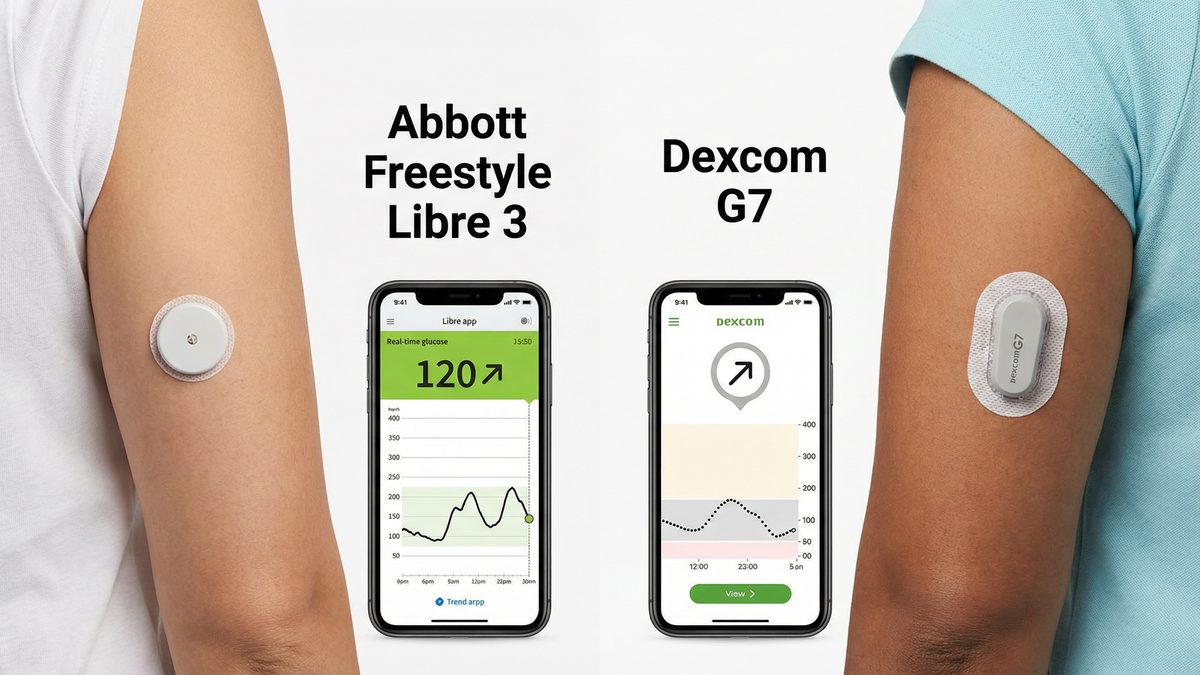
CGM Comparison: Freestyle Libre 3 vs Dexcom G7
Continuous Glucose Monitors (CGMs) have revolutionized diabetes management by providing real-time glucose readings without fingersticks. Two leading options—the Freestyle Libre 3 and Dexcom G7—offer impressive technology in compact packages. This comprehensive comparison will help you understand the key differences, benefits, and limitations of each system to determine which might better suit your diabetes management needs.
Understanding Continuous Glucose Monitoring
Before diving into the specifics of each device, it’s helpful to understand what continuous glucose monitoring is and why it has become such a valuable tool for people with diabetes. Unlike traditional fingerstick testing that provides a single reading at a specific moment, CGMs measure glucose levels in the interstitial fluid (the fluid between cells) throughout the day and night.
This continuous monitoring creates a more complete picture of glucose trends, helping users identify patterns, prevent hypoglycemia (low blood sugar), and make more informed decisions about insulin dosing, food choices, and physical activity.
ℹ️ Did You Know?
Studies show that consistent CGM use can reduce A1C levels by 0.3% to 0.5% and significantly decrease time spent in hypoglycemia. This technology doesn’t just offer convenience—it can lead to meaningful improvements in diabetes outcomes and quality of life.
Freestyle Libre 3: Overview
The Freestyle Libre 3, manufactured by Abbott, represents the third generation of their popular flash glucose monitoring system. Unlike earlier versions that required scanning the sensor with a reader or smartphone, the Libre 3 automatically transmits glucose readings to your smartphone every minute.
The Libre 3 sensor is remarkably thin—about the thickness of two pennies stacked together—making it the smallest CGM sensor available. It’s applied to the back of the upper arm and lasts for 14 days before requiring replacement.
Key Features of the Freestyle Libre 3
The Libre 3 offers several standout features that have made it popular among users:
- Real-time glucose readings sent automatically to your smartphone every minute
- Optional alarms for high and low glucose levels
- No fingerstick calibration required
- Small, discreet sensor (the world’s smallest CGM sensor)
- 14-day sensor wear
- One-piece applicator for simple sensor insertion
- Water-resistant for up to 30 minutes at a depth of 3 feet
- Compatible with both iOS and Android smartphones
Dexcom G7: Overview
The Dexcom G7 is the latest offering from Dexcom, a company that has specialized in CGM technology since 2006. The G7 represents a significant redesign from previous generations, with a 60% smaller sensor, simplified application, and improved accuracy.
Like the Libre 3, the G7 transmits readings automatically to a smartphone or receiver. It’s applied to the back of the upper arm or abdomen and lasts for 10 days before requiring replacement.
Key Features of the Dexcom G7
The Dexcom G7 includes several notable features:
- Real-time glucose readings sent automatically every 5 minutes
- Customizable alerts for high, low, and rapidly changing glucose levels
- No fingerstick calibration required (though optional if desired)
- 30-minute grace period when changing sensors (no data gap)
- 10-day sensor wear
- All-in-one, disposable design (no separate transmitter)
- Water-resistant for showering and swimming
- Compatibility with iOS and Android smartphones
- Optional dedicated receiver available
Head-to-Head Comparison
Now that we’ve outlined the basics of each system, let’s compare them directly across several important categories:
| Feature | Freestyle Libre 3 | Dexcom G7 |
|---|---|---|
| Sensor Size | Smallest available (size of 2 stacked pennies) | 60% smaller than G6, slightly larger than Libre 3 |
| Sensor Duration | 14 days | 10 days |
| Warm-up Time | 1 hour | 30 minutes |
| Reading Frequency | Every minute | Every 5 minutes |
| Approved Wear Locations | Back of upper arm only | Back of upper arm or abdomen (ages 2+) |
| Alert Customization | Basic high/low alerts | Extensive customization options |
| Data Sharing | Up to 20 people | Up to 10 followers |
| Compatibility with Automated Insulin Delivery | Limited (some DIY systems only) | Multiple commercial systems |
| MARD (Accuracy) | 7.9% | 8.2% |
Accuracy Considerations
Both the Freestyle Libre 3 and Dexcom G7 offer impressive accuracy compared to traditional blood glucose meters and earlier CGM systems. The Mean Absolute Relative Difference (MARD) is a common metric used to measure CGM accuracy, with lower percentages indicating better accuracy.
The Libre 3 reports a MARD of 7.9%, while the Dexcom G7 has a MARD of 8.2%. While the Libre 3 has a slight edge in this metric, both are considered highly accurate, and the difference is unlikely to be clinically significant for most users.
It’s worth noting that both systems can experience temporary inaccuracies due to factors like pressure on the sensor (such as sleeping on it), dehydration, certain medications, or during rapid glucose changes.
✅ Practical Tip
If your symptoms don’t match your CGM reading (for example, you feel low but your CGM shows normal levels), always confirm with a fingerstick test. Keep a traditional blood glucose meter as a backup for these situations, especially when making treatment decisions during extreme high or low readings.
Cost and Insurance Coverage
The cost of CGM systems can vary significantly based on insurance coverage. Without insurance, the Freestyle Libre 3 typically costs less than the Dexcom G7, both for the initial starter kit and for ongoing sensors.
Many insurance plans, including Medicare for those who qualify, now cover CGM systems for people with both type 1 and type 2 diabetes. Coverage criteria vary by insurer, but typically include insulin use and/or a history of problematic hypoglycemia.
For those with insurance coverage, the out-of-pocket costs may be similar for both systems. It’s worth checking with your insurance provider and comparing the specific copays or coinsurance amounts for each system.
Integration with Other Devices
One significant difference between these systems is their integration capabilities with insulin delivery devices. The Dexcom G7 is designed to work with multiple automated insulin delivery (AID) systems, including the Tandem t:slim X2 pump with Control-IQ technology and Omnipod 5.
The Freestyle Libre 3, while offering excellent standalone glucose monitoring, currently has more limited official integration with insulin pumps and automated systems. Some users utilize unofficial, DIY solutions to connect their Libre 3 with other devices, but these approaches aren’t FDA-approved and require technical knowledge.
If integration with an insulin pump or AID system is important to you, this could be a deciding factor in your choice between these two systems.
User Experience Considerations
Beyond the technical specifications, there are several user experience factors to consider:
Adhesive and Skin Reactions: Both companies have worked to improve their adhesives, but some users still experience skin irritation. The Dexcom G7’s smaller profile may be beneficial for those with adhesive sensitivities since it covers less skin area.
App Experience: Both systems offer user-friendly mobile apps, though some users prefer the more detailed reporting and customization options in the Dexcom app.
Alarms and Notifications: The Dexcom G7 offers more customizable alerts, including predictive alerts that warn you before you reach high or low levels. The Libre 3 has more basic alert functionality.
Discretion: The Libre 3’s smaller size makes it the more discreet option, though both are considerably smaller than previous generations.
✅ Key Takeaway
Both the Freestyle Libre 3 and Dexcom G7 represent significant advancements in CGM technology, offering reliable glucose monitoring in smaller, more user-friendly packages. The Libre 3 excels with its smaller size, longer wear time (14 days vs. 10), and slightly lower cost. The Dexcom G7 stands out with its faster warm-up time, integration with insulin delivery systems, and more customizable alerts. Your choice should be guided by your specific needs, considering factors like whether you use an insulin pump, how important extensive alerting is to you, and your insurance coverage.
Making Your Decision
When choosing between the Freestyle Libre 3 and Dexcom G7, consider these questions:
- Do you use an insulin pump or plan to in the future? If yes, the Dexcom G7’s integration capabilities may be valuable.
- How important are predictive and customizable alerts to your management? If very important, the Dexcom G7 offers more options.
- Is sensor size and discretion a priority? The Libre 3 has the edge here.
- Do you prefer longer wear time between sensor changes? The Libre 3 lasts 14 days versus the G7’s 10 days.
- What does your insurance cover? Sometimes coverage will be better
Related articles