The short answer
Glycaemic load usually matters more, because it counts both how fast a food raises glucose (its GI) and how many carbs are in the portion you actually eat.
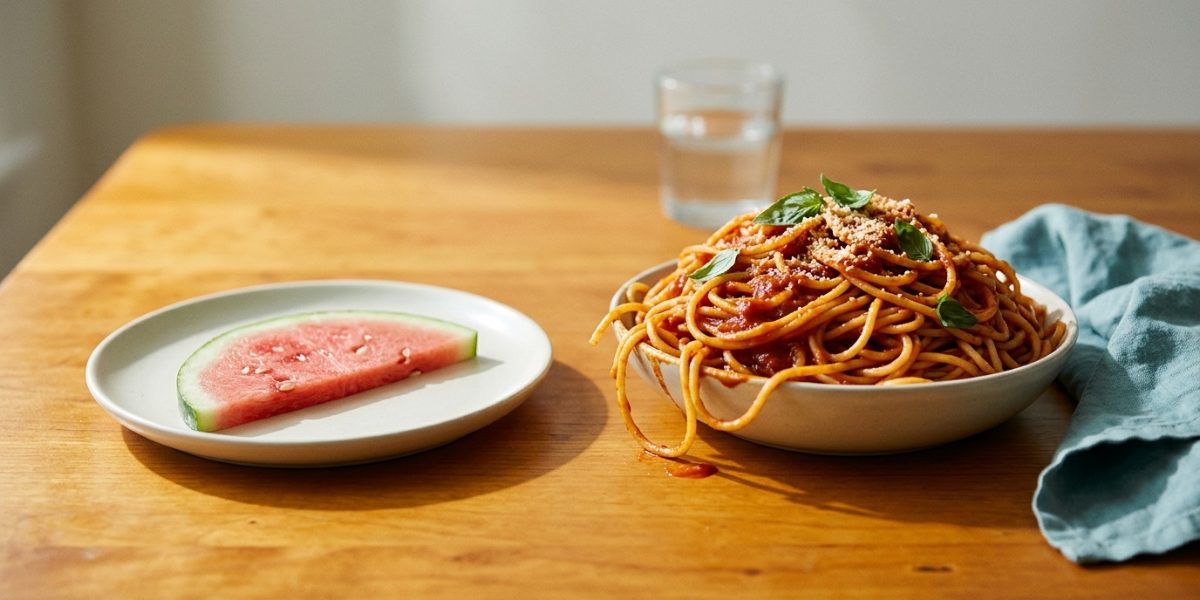
Glycaemic load = GI x grams of carbs in the portion, divided by 100. Under 10 is low, 20 or over is high. Watermelon is high GI but low GL; a big bowl of pasta is the reverse.
GI and GL sound alike. They answer different questions.
What’s the difference?
| Glycaemic index (GI) | Glycaemic load (GL) | |
|---|---|---|
| Question it answers | How fast do this food’s carbs raise glucose? | How much will this portion raise glucose? |
| Accounts for portion? | No | Yes |
| Low | 55 or under | 10 or under |
| Medium | 56 to 69 | 11 to 19 |
| High | 70 or over | 20 or over |
How do I work out GL?
GL = GI x grams of carbs in your portion, divided by 100.
So a food with a GI of 50, in a portion with 30 g of carbs, has a GL of 15.
Some worked examples
Approximate figures. Real values vary by type, cooking and portion.
| Food and portion | GI | Carbs | GL |
|---|---|---|---|
| Watermelon, 1 slice (120 g) | About 75 (high) | About 6 g | About 5 (low) |
| Lentils, cooked (150 g) | About 30 (low) | About 18 g | About 5 (low) |
| Spaghetti, large bowl (250 g cooked) | About 50 (low) | About 70 g | About 35 (high) |
| White rice, cooked (150 g) | About 70 (high) | About 42 g | About 29 (high) |
The watermelon looks bad on GI but a normal slice barely moves glucose. The pasta looks good on GI, but a big bowl carries a heavy load.
So which should I use?
- To choose between foods, GI helps: seeded bread over white, porridge over cornflakes.
- To judge a meal, GL is more useful, because portion is what really drives the rise.
- Day to day, you don’t need to calculate either. Pick lower-GI carbs and keep portions sensible. That gives you a lower GL automatically.
What neither tells you
- Whether a food is nutritious. Fizzy drinks and fruit can share a GL.
- How your own body responds. Checking your glucose after meals tells you that best.
- The effect of the whole meal. Protein, fat and vegetables slow things down.
Finding values, fruit and low-carb: where GL fits
Where do I find GI and GL values? The international GI tables list thousands of foods. Many food labels don’t show GI, so it’s easier to learn the main groups than to look up every item.
Does fruit have a high GL? Most whole fruit has a low GL in a normal portion, because of its water and fibre. Dried fruit and juice are much more concentrated.
Is a low-GL diet the same as low-carb? Not quite. Low-carb cuts the total amount. Low-GL lets you keep more carbs, as long as they’re slower ones in sensible portions. Both can lower glucose.
Should I count GL every day? Most people don’t need to. If you like numbers, try it for a week to learn which of your usual meals carry the biggest load, then stop counting.
The bottom line
GI is about the type of carb. GL is about type and amount. For blood sugar, amount usually matters more, so watch portions first and use GI to pick better options.
More: low-GI foods and easy swaps and how many carbs a day.
Sources
- Atkinson FS, et al. Am J Clin Nutr 2021. International tables of glycemic index and glycemic load values 2021.
- American Diabetes Association. Standards of Care in Diabetes 2026, section 5: Facilitating positive health behaviors and well-being.
General public information, not personalised treatment advice. Children, pregnancy and complex health conditions need individual specialist advice. Don’t start, stop or change a medicine without speaking to your own healthcare team.