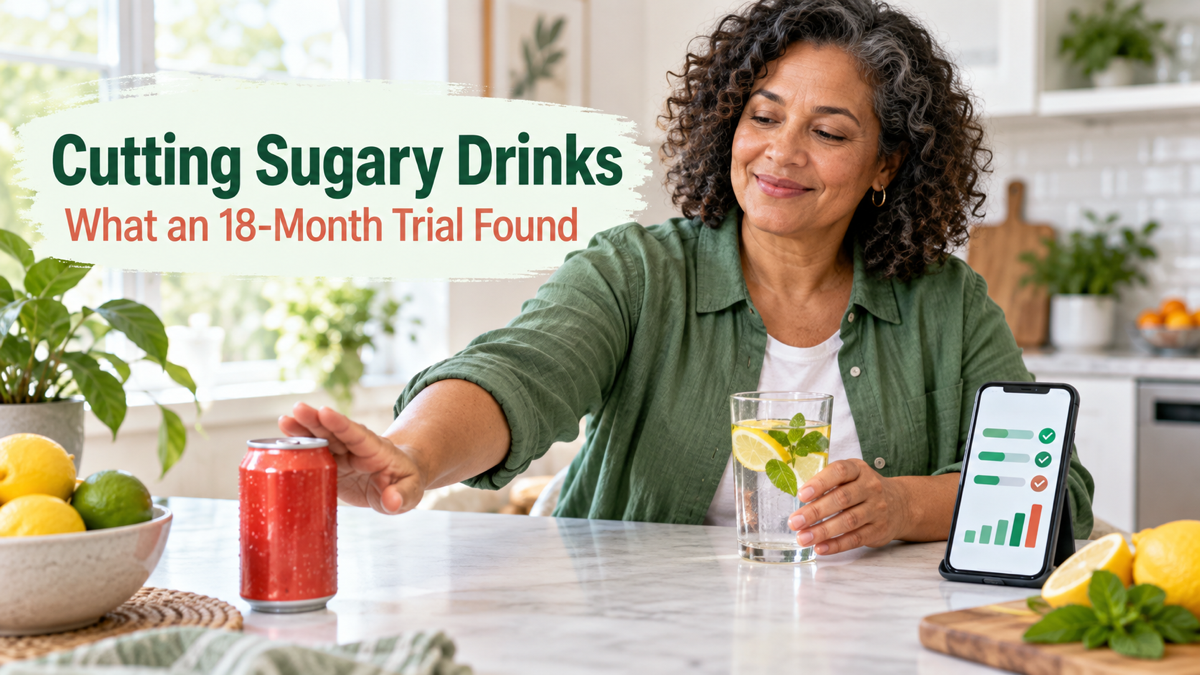
Can a digital programme help people cut back on sugary drinks for more than a few weeks? A new 18-month follow-up from a randomised controlled trial suggests that it can. Adults who received interactive online support, self-monitoring tools and personalised action planning reported a larger sustained reduction in sugary drinks than adults given a standard educational website. They also had modest average weight loss.
The findings are encouraging, but they need careful interpretation. Both groups substantially reduced their sugary-drink intake. The study did not test diabetes prevention, did not measure HbA1c as its main outcome and cannot prove that reducing sugary drinks caused all the observed weight change. The most useful lesson is not that one app is a cure. It is that structured support may help people turn good intentions into habits that last.
Key points
- The trial included 249 adults who regularly consumed sugary drinks; 211 remained in the study at 18 months.
- The interactive programme combined six online modules with drink tracking, personalised goals, text prompts and connected weighing scales.
- At 18 months, participants in the interactive group reported drinking about 30 fewer fluid ounces of sugary drinks per day than at the start, compared with about 21 fewer ounces in the education-only group.
- The interactive group lost about 3% of their starting body weight on average, while the comparison group had little average weight change.
- The study did not establish that the programme prevents type 2 diabetes or that the same results will apply to every population.
What counts as a sugary drink?
Sugar-sweetened beverages include ordinary fizzy drinks, sweetened fruit drinks, energy drinks, sports drinks, sweetened teas and coffees, and other drinks with added sugars. Some products that appear healthy can still contain a substantial amount of free sugar, so the nutrition label and serving size matter.
These drinks can deliver a large amount of sugar quickly and may not produce the same feeling of fullness as solid food. Frequent intake has been associated with weight gain, type 2 diabetes, heart disease and other health problems. The US Centers for Disease Control and Prevention recommends choosing water or unsweetened drinks more often. The World Health Organization recommends keeping free sugars below 10% of total daily energy intake, with a conditional suggestion that reducing intake below 5% may provide additional benefits.
This does not mean every sweet-tasting drink is identical. A sugar-free drink does not have the same sugar content as a regular version, and a whole piece of fruit is not equivalent to a sweetened fruit drink. The practical aim is to recognise the drinks that contribute added or free sugars most often and find realistic replacements.
How was the study designed?
Researchers enrolled 249 adults from predominantly rural Appalachian communities in the United States. Participants were regular consumers of sugary drinks and were randomly assigned to one of two groups:
- Interactive digital support: the iSIPsmarter programme included six online behavioural modules, self-monitoring, personalised action plans, text-message prompts and a cellular-enabled weighing scale.
- Static online education: participants received access to an educational website containing useful information, but without the same interactive coaching and tracking features.
This was therefore an active comparison, not an intervention versus no help at all. That distinction matters because both groups were exposed to information about sugary drinks, and both improved.
At 18 months, 211 participants remained in the study, representing 85% of those originally randomised. The follow-up group was mostly female and White, and most participants had overweight or obesity. These characteristics help us understand who took part, but they also limit how confidently the results can be applied to more diverse populations.
What happened after 18 months?
Participants in the interactive programme reported reducing their sugary-drink intake by an average of 30.1 fluid ounces per day from baseline. The education-only group reported an average reduction of 20.9 ounces per day. The between-group difference was statistically significant, although the size of the difference was modest.
For perspective, 30 fluid ounces is roughly 890 millilitres, while 21 ounces is about 620 millilitres. These figures describe average changes in a group of people who began the study with high intake. They are not targets that everyone should try to copy.
The weight findings also favoured the interactive programme. Participants in that group lost about 3% of their starting weight on average, while the comparison group had approximately no average percentage change. A person starting at 100 kilograms would have a 3-kilogram change if their result matched the group average, but individual responses can vary widely.
The researchers’ mediation analysis suggested that part of the weight difference may have operated through the reduction in sugary-drink intake. However, the statistical result was borderline, and other changes in behaviour may also have contributed. It would be too strong to say that the drink reduction alone caused all of the weight loss.
Why did the education-only group improve too?
One of the most interesting findings is that the comparison group also reported a large reduction in sugary drinks. Simply receiving clear information, paying attention to beverage choices and taking part in a health study may prompt change. This is not a failure of the intervention. It shows that accessible education can be useful, while interactive tools may add a further benefit for some people.
The study also highlights the difference between knowing and doing. Most people already understand that drinking less sugar may be helpful. The harder work is noticing routines, planning alternatives, responding to setbacks and continuing after initial motivation fades. Tracking, prompts and personalised goals are designed to support those steps.
What does this mean for people with diabetes or prediabetes?
Replacing regularly consumed sugary drinks with water or unsweetened alternatives can reduce a concentrated source of carbohydrate and calories. For someone living with diabetes, this may also reduce large glucose rises linked to those drinks. However, the trial was not designed to show changes in HbA1c, diabetes medication needs or diabetes complications, so those outcomes should not be inferred from the results.
People taking insulin or medicines that can cause hypoglycaemia, such as sulfonylureas, may need more individual planning when changing carbohydrate intake. Glucose readings and treatment may need review if the change is substantial. Do not stop or adjust prescribed medicines without advice from your healthcare team.
There is also an important exception: fast-acting glucose may be needed to treat hypoglycaemia. Sugary drinks used as part of an agreed hypo treatment plan are different from routine sugary-drink consumption. Keep your prescribed hypo treatment available and follow your personal diabetes plan.
What the study does not prove
Good evidence is easier to use when its limits are visible. This trial does not show that:
- a digital programme will work equally well for everyone;
- cutting sugary drinks alone prevents or reverses type 2 diabetes;
- all apps or text-message programmes are effective;
- the reported weight change came only from beverage choices; or
- people who already drink few or no sugary drinks would obtain the same benefit.
Sugary-drink intake was self-reported, which can be affected by memory and by a desire to give socially acceptable answers. Participants knew which intervention they received, as is usually unavoidable in a behavioural study. The sample came mainly from one US region and included a high proportion of White women, so further research in more diverse communities is needed.
Practical ways to reduce sugary drinks
You do not need the exact programme used in the trial to borrow its behavioural principles. A practical approach might include:
- Track before changing. Record what you drink for three to seven days, including approximate amounts and the situations in which sugary drinks are most likely.
- Choose one frequent drink first. Replacing a daily drink is usually more manageable than trying to change every habit at once.
- Make the alternative easy. Keep cold water, sparkling water, unsweetened tea or another suitable option readily available.
- Use flavour without added sugar. Citrus slices, mint, cucumber or a small amount of no-added-sugar flavouring may make water more appealing.
- Reduce gradually if needed. Smaller servings, fewer days per week or progressively less sugar in tea and coffee can be a workable route.
- Plan for predictable triggers. Decide in advance what you will order at restaurants, buy during travel or choose when tired.
- Use reminders with a purpose. A phone reminder can prompt a planned action, such as filling a water bottle, rather than simply displaying a generic health message.
- Review without judgement. A difficult day is information, not failure. Look for the trigger and adjust the plan.
If plain water is difficult, the best alternative is one that is lower in sugar, acceptable to you and sustainable. Some people use non-sugar sweetened drinks as a transition. They can reduce sugar exposure compared with regular sugary drinks, but they are not essential, and water or unsweetened drinks remain straightforward choices.
The bottom line
This 18-month trial provides useful evidence that an interactive digital programme can help adults sustain larger reductions in sugary-drink intake than static online education alone. The programme was also associated with modest average weight loss. Just as importantly, the education-only group improved substantially, showing that clear information and focused attention can support change too.
For the general public, the message is practical rather than dramatic: if sugary drinks are a regular part of your day, reducing them is a meaningful health goal, and simple digital tools may help you plan, track and persist. For people with diabetes, major changes should fit safely with glucose-lowering medicines and an agreed hypoglycaemia plan.
Sources
- Zoellner JM, et al. Reductions in sugar-sweetened beverage intake and weight are maintained following a digital health intervention: findings from a randomized-controlled trial. Journal of the Academy of Nutrition and Dietetics. 2026. doi:10.1016/j.jand.2026.156877.
- Zoellner JM, et al. A digital behavioral intervention to reduce sugar-sweetened beverage consumption: a randomized, controlled trial. The American Journal of Clinical Nutrition. 2025. doi:10.1016/j.ajcnut.2025.06.010.
- Centers for Disease Control and Prevention: Fast Facts: Sugar-Sweetened Beverage Consumption.
- World Health Organization: Guideline on sugars intake for adults and children.
This article is for general education and does not replace personalised medical advice. Speak with your healthcare team before making major dietary or medication changes, particularly if you use insulin or medicines that can cause hypoglycaemia.