A small randomized trial has tested real-time continuous glucose monitoring in adults with type 2 diabetes who use insulin and receive maintenance haemodialysis. The results suggest that seeing glucose readings and trends continuously may help people spend more time in their target glucose range and less time with high glucose than relying on finger-prick checks alone.
The study did not show a reduction in its primary outcome, time spent with glucose below 70 mg/dL. It was also too small and too short to tell us whether continuous glucose monitoring, usually called CGM, reduces hospital admissions or long-term complications.
That balance matters. The findings are encouraging, but they do not mean that every person receiving dialysis should immediately change devices or adjust insulin without medical guidance.
Key takeaways
- The trial involved adults with type 2 diabetes who were using insulin and receiving haemodialysis.
- Fifty-three people entered the study, while 39 had enough usable data from both treatment periods for the main comparison.
- Participants used real-time CGM for four weeks and finger-prick glucose monitoring for four weeks, with a two-week washout period between them.
- Time in the target range of 70 to 180 mg/dL was higher during real-time CGM: 63.4% compared with 54.5% during finger-prick monitoring.
- Time spent above 180 mg/dL and above 250 mg/dL was lower during the CGM period.
- The primary outcome, time below 70 mg/dL, was low in both periods and was not significantly different.
- The trial did not establish that CGM prevents hospital admissions, dialysis complications, heart events or other long-term outcomes.
Why glucose monitoring can be difficult during dialysis
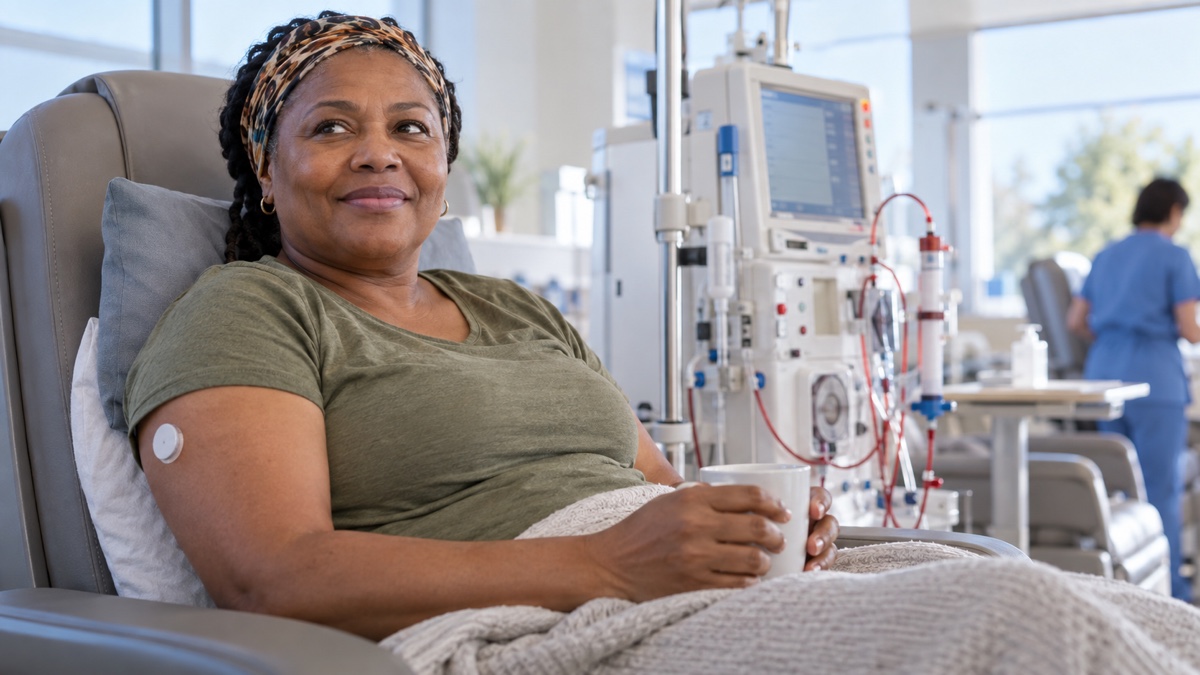
Haemodialysis removes waste products and excess fluid from the blood when the kidneys can no longer do this adequately. For people who also live with diabetes, treatment can make glucose management more complicated.
Appetite, meal timing, insulin needs and glucose levels may differ on dialysis and non-dialysis days. Kidney failure can also change how the body handles insulin. At the same time, anaemia, altered red blood cell survival and treatments used during dialysis can make HbA1c less straightforward to interpret in some people.
Finger-prick checks remain useful, but they provide readings at individual moments. A CGM sensor measures glucose in the fluid beneath the skin throughout the day and night. It can show trends, alert users to high or low readings and reveal patterns between scheduled checks.
More data do not automatically lead to safer treatment. The information has to be interpreted in the context of dialysis timing, meals, symptoms and prescribed insulin. This is one reason the study is useful: it tested whether access to real-time information changed glucose patterns in a medically complex group.
How the randomized trial worked
The study was a prospective randomized crossover trial. In a crossover study, participants try both approaches at different times, so each person can contribute information to both sides of the comparison.
Adults aged 18 to 80 were eligible if they had type 2 diabetes, had received haemodialysis for at least 90 days, used insulin and normally checked glucose at least twice daily. People who had recently used personal real-time CGM or an insulin pump were among those excluded.
Participants were randomly assigned to start with either real-time CGM or standard finger-prick monitoring. Each period lasted four weeks, separated by a two-week washout. During the finger-prick period, a professional sensor still collected blinded data for the researchers, but participants could not use those readings to guide treatment.
Sixty-six people signed consent forms, 53 began the study and 40 completed both periods. One person was excluded from the paired analysis because of missing CGM data, leaving 39 participants with usable data for both approaches.
What did the trial find?
The study’s primary question was whether real-time CGM would reduce the percentage of time participants spent below 70 mg/dL. It did not. Time below range averaged 1.17% during real-time CGM and 1.29% during finger-prick monitoring, a difference that was not statistically significant.
The main positive findings were secondary glucose measures:
- Time in range, 70 to 180 mg/dL: 63.4% with real-time CGM versus 54.5% with finger-prick monitoring.
- Average glucose: 173.6 mg/dL with real-time CGM versus 187.7 mg/dL with finger-prick monitoring.
- Time above 180 mg/dL: 35.3% with real-time CGM versus 44.3% with finger-prick monitoring.
- Time above 250 mg/dL: 12.3% with real-time CGM versus 18.8% with finger-prick monitoring.
These differences favoured real-time CGM and were statistically significant. The improvement came mainly from spending less time with high glucose, not from reducing low glucose.
An increase from 54.5% to 63.4% in time in range is equivalent to a little over two additional hours per day within the 70 to 180 mg/dL range. This is a useful way to understand the size of the difference, but it should not be interpreted as a guarantee for an individual user.
Why the neutral primary result matters
News reports can focus on whichever result sounds most positive. In this trial, however, the prespecified primary outcome was time below range. That outcome did not improve.
The researchers expected low glucose to be an important problem in this population, but time below range was already low during both study periods. When an outcome is uncommon at baseline, there may be little room for an intervention to reduce it further.
The improved time in range and reduced time above range are encouraging secondary findings. They support further study, but they carry less certainty than a successful primary outcome. This distinction does not make the trial unhelpful. It tells us exactly what the study can and cannot support.
What the study does not prove
The trial has several important limitations:
- Only 39 participants contributed usable paired data to the main comparison.
- Each monitoring period lasted four weeks, so the study provides short-term glucose information.
- All participants used insulin and received haemodialysis. The findings should not automatically be applied to people who do not use insulin, use peritoneal dialysis or have earlier-stage kidney disease.
- Participants and clinicians knew when real-time CGM was being used, which may have affected behaviour and treatment decisions.
- The study was not designed to show reductions in hospital admission, heart events, dialysis complications or death.
- Longer-term HbA1c and post-study hospitalisation outcomes were not available from the dialysis centre.
The researchers concluded that larger studies are needed to confirm the benefits and determine whether improvements in glucose patterns lead to better clinical outcomes.
What this could mean for patients
For an insulin-treated person receiving haemodialysis, CGM may provide a fuller picture than occasional finger-prick readings alone. It could help identify repeated high readings, changes around dialysis sessions and times when insulin or meal planning deserves review.
It is not a substitute for the diabetes and kidney-care teams. Dialysis, reduced kidney function and changes in food intake can all alter insulin requirements. Acting on one reading without considering the trend, symptoms and treatment plan can be unsafe.
People interested in CGM can ask whether a device is appropriate for them, whether it is approved and funded in their health system, how accurate it is expected to be during dialysis and what to do when a sensor reading does not match symptoms.
Using CGM more safely during haemodialysis
- Agree in advance which glucose targets and alerts your care team recommends.
- Do not change prescribed insulin doses solely because of this study.
- Ask when a finger-prick check is needed to confirm a sensor result, particularly if symptoms and readings do not match.
- Keep treatment for low glucose available according to your personalised kidney and diabetes plan.
- Share patterns rather than isolated numbers with the diabetes and dialysis teams.
- Ask how dialysis-day meals, missed meals and fluid restrictions should be handled.
- Report repeated low readings, severe high readings, sensor-site problems or unexpected changes promptly.
Questions to ask your care team
- Would real-time CGM add useful information in my situation?
- What should my target range be, and does it differ on dialysis days?
- Which readings require a confirmatory finger-prick test?
- Who should review my CGM reports: the diabetes team, dialysis team or both?
- What should I do if the sensor shows a rapid fall or repeated low readings?
- Could anaemia or dialysis treatment affect how we interpret my HbA1c?
- Is the device covered by my healthcare system or insurance?
When to seek urgent help
Follow your personalised emergency plan for low or very high glucose. Seek urgent medical help for severe confusion, loss of consciousness, a seizure, difficulty breathing, persistent vomiting, chest pain or symptoms of diabetic ketoacidosis. If a CGM alarm conflicts with how you feel, confirm the reading when possible without delaying emergency treatment.
The bottom line
In this small randomized crossover trial, real-time CGM did not reduce time below range in insulin-treated adults with type 2 diabetes receiving haemodialysis. It did increase time in range and reduce time with high glucose over four weeks compared with finger-prick monitoring.
The result supports a careful conversation about CGM as a monitoring option, not a universal recommendation or a reason to change insulin independently. Larger and longer studies are needed to determine whether these glucose improvements translate into fewer complications and better quality of life.
Sources
- Galindo RJ, Moazzami B, Gerges A, et al. Real-Time Continuous Glucose Monitoring Among People With Type 2 Diabetes and End-Stage Kidney Failure Undergoing Maintenance Hemodialysis: A Randomized Clinical Trial. Diabetes Care. 2026;49(9):1621-1626. doi:10.2337/dc26-0404.
- US National Library of Medicine. PubMed record for the randomized clinical trial. PMID: 42360278.
- ClinicalTrials.gov. NCT04473430 study record and posted results.
This article provides general education and is not individual medical advice. Decisions about glucose monitoring, dialysis care and insulin should be made with qualified healthcare professionals who know your medical history.