The short answer
The main treatment is anti-VEGF injections into the eye, monthly at first and then less often. They’re first choice when swelling involves the centre of the macula and has affected sight.
Laser and steroid implants are used when the centre isn’t involved, when injections don’t work well enough, or when they don’t suit you.
Diabetic macular oedema is swelling at the centre of the retina. It’s the commonest cause of sight loss from diabetes, and it’s very treatable. Here’s how the options compare.
What is it?
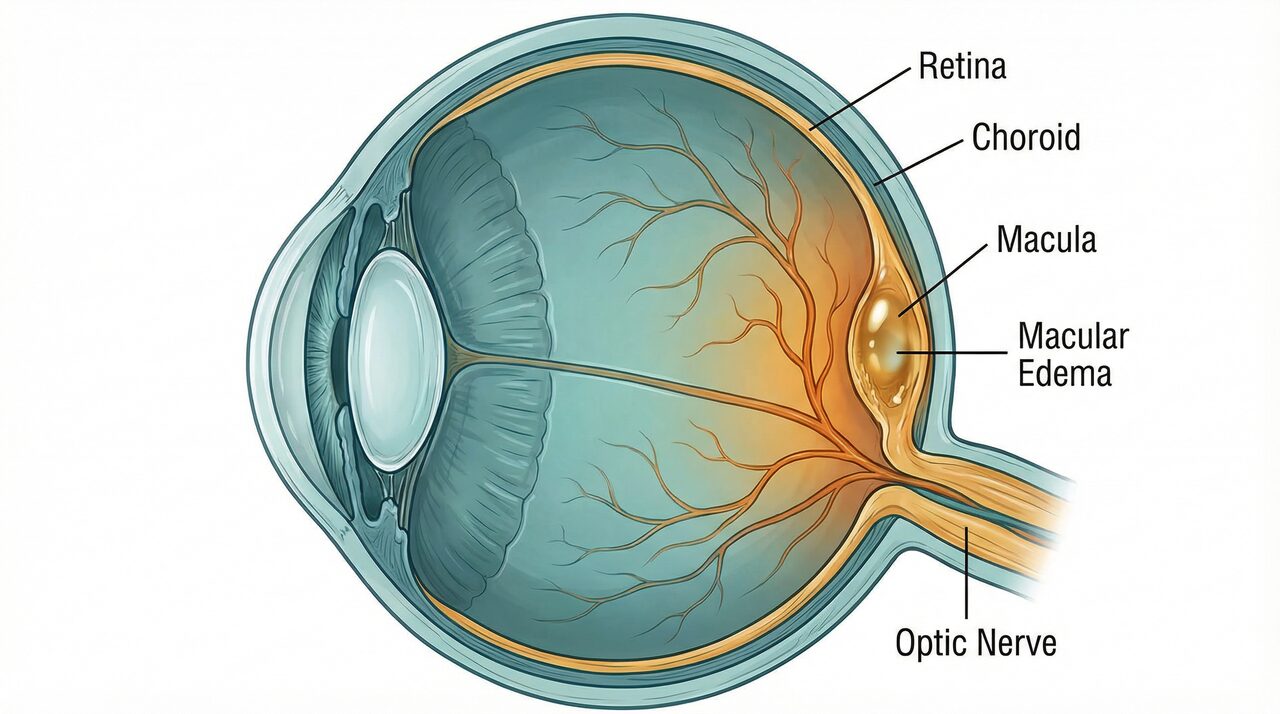
The macula is the small central part of the retina you use for reading, faces and fine detail. In diabetes, damaged blood vessels can leak fluid into it. The macula swells and central vision blurs.
It can happen at any stage of retinopathy. Early on there are no symptoms, which is why it’s usually found at eye screening and confirmed with an OCT scan, a quick painless scan that shows the layers of the retina.
Doctors divide it by whether the very centre is involved. That decides the treatment.
What are the treatments?
| Treatment | How it works | When it’s used | Main downsides |
|---|---|---|---|
| Anti-VEGF injections | Block a protein (VEGF) that makes vessels leak | First choice when the centre is involved and vision is affected | Repeated visits. Small risk of infection. |
| Macular laser | Seals leaking spots | When swelling doesn’t involve the centre, or added if injections aren’t enough | Works slowly. Stabilises more than it improves. |
| Steroid implants | A tiny implant releases steroid inside the eye for months | If injections haven’t worked well enough, or don’t suit you | Cataract and raised eye pressure |
What are anti-VEGF injections like?
The medicines include aflibercept (Eylea), ranibizumab (Lucentis), bevacizumab (Avastin) and faricimab (Vabysmo).
The idea of a needle in the eye sounds awful. In practice it’s quick.
- The eye is numbed with drops and cleaned to prevent infection.
- The medicine goes in through the white of the eye with a very fine needle. It takes seconds. Most people feel pressure, not pain.
- You can usually get back to normal activities afterwards.
- The eye may feel gritty for a day or two, and you may see small floating bubbles. They clear.
Injections are usually monthly to begin with, then spaced out. Some people eventually stop. Others need them long term.
How well do they work?
In a US trial of 660 adults with macular oedema involving the centre, vision improved over a year with all three medicines tested: by about 13 letters on the eye chart with aflibercept, 11 with ranibizumab and 10 with bevacizumab. Five letters is one line of the chart.
When vision was only mildly affected at the start, the three did equally well. When it was worse at the start, aflibercept did best.
Serious side effects were no different between the groups.
What if my vision is still good?
You may not need injections straight away. UK guidance says that for centre-involving oedema with good vision, either macular laser or careful watching is reasonable. You and your eye specialist decide together.
When are steroid implants used?
UK guidance suggests thinking about a switch to a steroid implant if the response to injections is poor after 12 months, or if you can’t keep up with regular injections.
The implants are dexamethasone (Ozurdex), which lasts a few months, and fluocinolone (Iluvien), which lasts much longer. Both can bring on cataracts and raise eye pressure, so they’re easier choices if you’ve already had cataract surgery. Pressure is checked regularly.
What are the risks of treatment?
- Infection inside the eye. Rare, but serious. Call your eye unit straight away if pain or vision gets worse in the days after an injection.
- Cataract and glaucoma with steroids. See diabetes and glaucoma.
- Small blind spots near the centre with macular laser, which is why it’s kept away from the very middle.
What can I do to help it work?
Treatment in the eye works better when the rest is under control.
- Glucose. Better control slows retinopathy. But a rapid, large drop in HbA1c can briefly worsen it. If you’re starting a treatment likely to do that, your eye specialist should know, so your eyes can be checked before and after.
- Blood pressure and cholesterol. Both matter for the retina.
- Fenofibrate. UK guidance says eye specialists should consider it for people with type 2 diabetes and early retinopathy, to slow progression.
- Don’t miss appointments. Gaps in injections are one of the main reasons vision slips back.
What should I ask my eye specialist?
- Is the centre of my macula involved?
- Which treatment do you recommend, and why?
- How many injections should I expect in the first year?
- What happens if it doesn’t respond?
- Who do I call if the eye becomes painful or red?
The bottom line
Injections are the main treatment and most people gain vision. Laser and steroid implants are backups. Turn up for every appointment, and look after glucose and blood pressure alongside.
More: laser treatment for diabetic retinopathy, why you need a regular dilated eye exam and sudden vision changes.
Sources
- Diabetic Retinopathy Clinical Research Network. Aflibercept, bevacizumab, or ranibizumab for diabetic macular edema. New England Journal of Medicine, 2015.
- National Institute for Health and Care Excellence. Diabetic retinopathy: management and monitoring (NG242).
- American Diabetes Association. Standards of Care in Diabetes 2026, section 12: Retinopathy, neuropathy, and foot care.
- National Eye Institute. Injections to treat diabetic retinopathy and diabetic macular edema.
- NHS. Diabetic retinopathy: treatment.
General public information, not personalised treatment advice. Children, pregnancy and complex health conditions need individual specialist advice. Don’t start, stop or change a medicine without speaking to your own healthcare team.