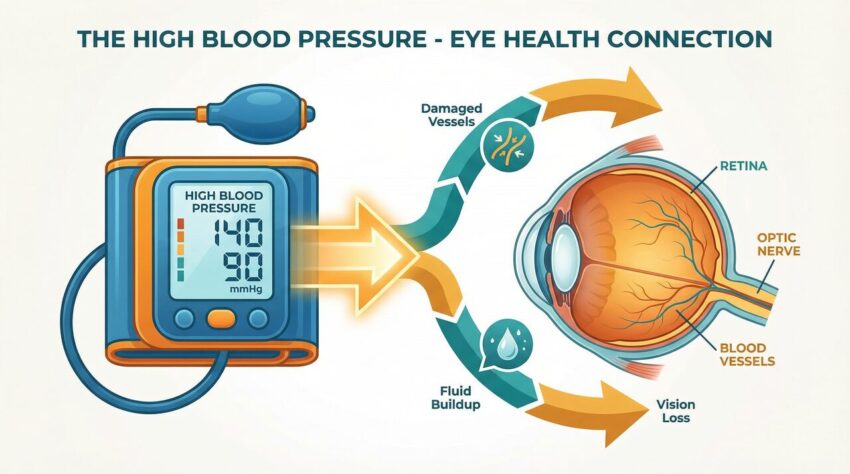
Hypertension, or high blood pressure, is one of the most widespread health challenges faced worldwide today, affecting billions of people across diverse populations. Often called the “silent killer,” this condition quietly damages the body because many individuals remain unaware of their elevated blood pressure until serious complications arise. While the devastating effects of hypertension on the heart, kidneys, and brain are well known, its impact on the eyes is equally critical but sometimes overlooked. The delicate retinal blood vessels are particularly susceptible to damage from chronic hypertension, leading to a condition known as hypertensive retinopathy. Observed annually on May 17th, World Hypertension Day underscores the importance of awareness, accurate blood pressure monitoring, and effective management to prevent not only cardiovascular events but also the subtle yet significant consequences for vision.
The Eye: A Window into Vascular Health
What makes the eye unique in understanding hypertension is the retina’s microvasculature, which can be directly observed non-invasively during a routine eye examination. This allows clinicians a rare glimpse into the body’s systemic vascular condition in real time. When blood pressure remains elevated—whether gradually or suddenly—it disrupts the fragile balance within these tiny vessels, setting off a chain reaction of changes that can ultimately threaten vision.
How Hypertension Harms the Retina: Pathogenesis of Hypertensive Retinopathy
Hypertensive retinopathy is a dynamic disease process that evolves in stages, each characterized by distinct vascular alterations.
ℹ️ Vasoconstrictive Phase
At the onset, the small arteries and arterioles in the retina constrict as a defensive response to increased blood pressure. This autoregulatory vasospasm aims to protect the retinal capillaries from excessive pressure. Clinically, this narrowing manifests as a generalized reduction in the caliber of retinal arterioles. The arteriovenous ratio (AVR), a key clinical measurement comparing arteriole to venule width, typically decreases in hypertensive patients. Research consistently shows lower central retinal artery equivalent (CRAE) and AVR values in individuals with hypertension, indicating reduced blood flow capacity within these vessels [1].
ℹ️ Sclerotic Phase
Persistent hypertension results in structural remodeling of the blood vessel walls. Chronic high pressure prompts thickening of the intima, proliferation of smooth muscle cells (medial hyperplasia), and the accumulation of hyaline material. These pathological changes cause more pronounced arteriolar narrowing and lead to characteristic appearances such as “copper wiring” or “silver wiring” seen in fundoscopic examinations. One hallmark of this phase is arteriovenous (AV) nicking, where the stiffened arteriole compresses the underlying venule at crossing points. This leads to venous constriction downstream, causing the veins to appear dilated and tortuous—signs of chronic vascular injury [2].
ℹ️ Exudative Phase
When blood pressure becomes severely elevated, it overwhelms the compensatory mechanisms regulating blood flow. As a result, the blood-retinal barrier breaks down, allowing fluid, lipids, and blood to leak into retinal tissue. This leakage underlies the appearance of microaneurysms, flame-shaped hemorrhages confined to the nerve fiber layer, deeper dot-blot hemorrhages, hard exudates (lipid deposits), and cotton wool spots. Cotton wool spots, also called “soft exudates,” reflect localized ischemic injury in the nerve fiber layer due to occlusion of precapillary arterioles—disrupting normal axoplasmic flow in retinal ganglion cells [2]. In the most severe scenarios, swelling of the optic disc (papilledema) occurs, typically indicating malignant hypertension and elevated intracranial pressure, a true ophthalmic emergency.
Beyond Retinopathy: Broader Ocular Consequences of Hypertension
Hypertension’s impact on the eye is not limited to retinopathy alone. One crucial interaction is its role in worsening diabetic retinopathy. High blood pressure accelerates retinal ischemia and vascular damage in diabetic patients, increasing the risk of severe vision loss. This synergistic effect highlights why blood pressure control is essential for people living with diabetes to protect their eyesight [3].
Additionally, hypertension may raise intraocular pressure (IOP), a recognized risk factor for glaucoma—a disease marked by progressive optic nerve damage and irreversible vision loss. Furthermore, elevated blood pressure can induce thrombotic events within the retinal vasculature, such as retinal artery or vein occlusions, which may cause sudden and profound vision impairment.
Clinical Detection and Management Strategies
Addressing hypertension’s ocular complications begins with early detection and vigilant blood pressure management. Current clinical guidelines recommend that most adults maintain a target blood pressure below 130/80 mmHg, though individualized targets may vary depending on other health factors [4]. Regular blood pressure monitoring — both at home and in clinical settings — ensures timely diagnosis and helps guide treatment.
Ophthalmic examinations, particularly fundoscopic assessments, play a pivotal role in identifying early signs of hypertensive retinopathy. For patients with longstanding or poorly controlled hypertension, routine eye exams are critical for detecting subtle vascular changes before vision is permanently affected. In fact, the severity of hypertensive retinopathy correlates with systemic cardiovascular risks, positioning retinal examination findings as valuable prognostic tools. As such, optimal care requires a multidisciplinary approach, with coordinated efforts among primary care providers, cardiologists, and ophthalmologists.
Emphasizing Prevention: Lifestyle and Therapeutic Modifications
While pharmacotherapy is often necessary to control hypertension, lifestyle changes remain foundational in both prevention and management:
- Dietary adjustments: The DASH (Dietary Approaches to Stop Hypertension) diet—emphasizing fruits, vegetables, whole grains, low-fat dairy, and lean protein while limiting sodium intake—has a well-documented blood pressure–lowering effect.
- Physical activity: Engaging in at least 150 minutes of moderate aerobic exercise weekly (or 75 minutes of vigorous activity) not only improves cardiovascular health but also contributes to maintaining healthy vascular tone and blood pressure levels.
- Weight management: Reducing overweight and obesity reduces the workload on the cardiovascular system and aids in blood pressure control.
- Limiting alcohol and tobacco: Both excessive alcohol use and smoking increase hypertension risk and exacerbate vascular damage. Cessation and moderation are strongly advised.
- Stress reduction: Chronic psychological stress increases sympathetic nervous system activity, raising blood pressure. Techniques such as mindfulness, yoga, and meditation can help mitigate this effect.
✅ Key Takeaway
World Hypertension Day is a powerful reminder that managing high blood pressure goes far beyond preventing heart attacks and strokes. The eyes provide a unique vantage point from which to observe the systemic effects of hypertension. Hypertensive retinopathy, along with hypertensive choroidopathy and optic neuropathy, illustrates how unchecked blood pressure silently harms one’s vision. By increasing awareness, promoting early diagnosis through regular eye exams, and committing to comprehensive blood pressure management paired with healthy lifestyle choices, individuals can substantially reduce their risk of vision loss and other devastating complications. Ultimately, protecting the eyes in hypertension is not just about preserving sight—it’s an integral part of safeguarding overall vascular health and enhancing quality of life.
References
[1] Dziedziak, J., Zaleska-Żmijewska, A., Szaflik, J. P., & Cudnoch-Jędrzejewska, A. (2022). Impact of Arterial Hypertension on the Eye: A Review of the Pathogenesis, Diagnostic Methods, and Treatment of Hypertensive Retinopathy. Medical Science Monitor, 28, e935135-1–e935135-12. https://pmc.ncbi.nlm.nih.gov/articles/PMC8790937/
[2] Tripathy, K., & Arsiwalla, T. (2025). Hypertensive Retinopathy. StatPearls Publishing. https://www.ncbi.nlm.nih.gov/books/NBK525980/
[3] Alamo Eye Care. (n.d.). The Link Between High Blood Pressure and Diabetic Eye Disease. https://www.alamoeyecare.com/blog/the-link-between-high-blood-pressure-and-diabetic-eye-disease.html
[4] American Heart Association. (2025). New high blood pressure guideline emphasizes prevention, early treatment to reduce CVD risk. https://newsroom.heart.org/news/new-high-blood-pressure-guideline-emphasizes-prevention-early-treatment-to-reduce-cvd-risk
 English
  Urdu
Urdu